




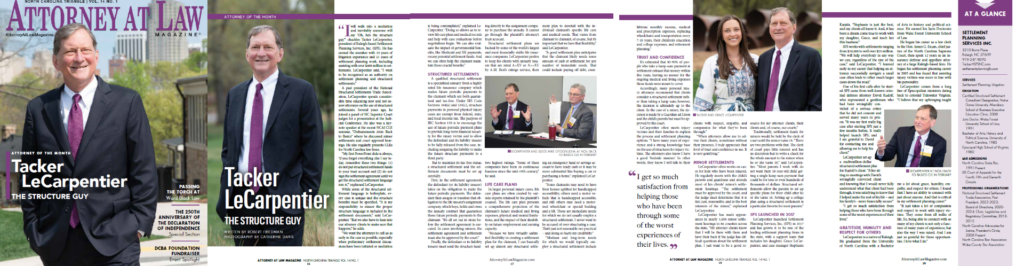



Tacker LeCarpentier: The Structure Guy

“I will walk into a mediation and inevitably someone will say ‘Oh, he’s the structure guy,’” chuckles Tacker LeCarpentier, president of Raleigh-based Settlement Planning Services, Inc. (SPS). He has earned the moniker with 35 years of litigation experience and 21 years of settlement planning work, including assisting with over $400 million in settlements. LeCarpentier said, “I want to be recognized as an authority on settlement planning and structured settlements.”

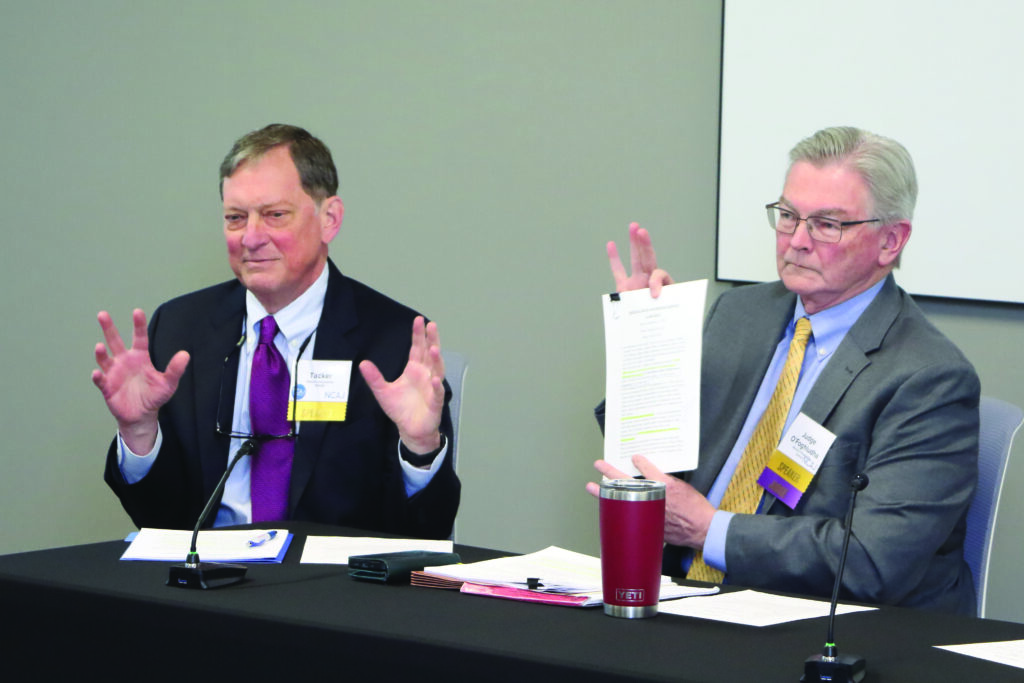
A past president of the National Structured Settlements Trade Association, LeCarpentier spends considerable time educating new and not-so-new attorneys on the use of structured settlements. Several years ago, he joined a panel of NC Superior Court judges for a presentation at the Judicial Conference. He also was a keynote speaker at the recent NCAJ CLE seminar, “Disbursements 2026: Back to Basics” where he discussed minor settlements and court approval hearings. He also regularly presents CLEs for North Carolina law firms.

“My first PowerPoint slide is always, ‘if you forget everything else I say today, remember these two things: (1) do not put structured settlement funds in your trust account and (2) do not sign the settlement agreement until we get the structured settlement language into it,’” explained LeCarpentier.

While some of the structured settlement language is boilerplate, every case is unique and the structure benefits must be specified. “It is my responsibility to ensure the proper structure language is included in the settlement documents,” said LeCarpentier. “But we also have to lean into our attorney clients to make sure that happens,” he adds.

“We want the attorneys to call us as early in the case as possible, especially when preliminary settlement discussions have been initiated or mediation is being contemplated,” explained LeCarpentier. “Doing so allows us to review life care plans and medical records and help with case evaluations before negotiations begin. We can also evaluate the impact of governmental benefits, like Medicaid and SSI payments, on any potential settlement funds. And we can often help the claimant maintain those crucial benefits.”

Structured Settlements

A qualified structured settlement is a specialized annuity from a highly rated life insurance company which makes future periodic payments to the claimant which are both guaranteed and tax-free. Under IRS Code Sections 104(a) and 130(c), structure payments in personal physical injury cases are exempt from federal, state, and local income tax. The purpose of IRC Section 130 is to encourage the use of future periodic payment plans to provide long-term financial security for the injury victim and to allow the defendant and its liability insurer to be fully released from the case, including assigning the liability to make the future structure payments to a third party.

 But to maintain its tax-free status, a structured settlement and the settlement documents must be set up carefully.

First, in the settlement agreement, the defendant (or its liability insurer) takes on the obligation to make the future periodic payments. The defendant then assigns or transfers that obligation to the life insurer’s assignment company, which buys, holds and owns the annuity contract that guarantees those future periodic payments to the claimant. “It’s all set out in stone before the settlement agreement is executed. In cases involving minors, the settlement agreement and settlement must also be approved by the court.”

Finally, the defendant or its liability insurer must send the structure funding directly to the assignment company to purchase the annuity. It cannot go through the plaintiff’s attorney’s trust account.

Structured settlement plans are backed by some of the world’s largest and most financially stable life insurance companies. LeCarpentier prefers to keep his clients with annuity issuers that are rated A+XV or A++XV by A.M. Best’s ratings service, their two highest ratings. “Some of these companies have been in continuous business since the mid-19th century,” he said.


Life Care Plans

In larger personal injury cases, life care plans are often created by outside experts retained by the plaintiff’s counsel. The life care plan presents a comprehensive projection of the claimant’s future medical and living expenses, physical and mental limitations, and the impact of their disability on future employment and earning capacity.

“Because we have virtually unlimited flexibility in creating a settlement plan for the claimant, I can basically set up almost any structured settlement plan to dovetail with the individual claimant’s specific life care and medical needs. That varies from claimant to claimant, of course, but it’s important that we have that flexibility,” said LeCarpentier.

“A good settlement plan anticipates that the claimant likely needs some amount of cash at settlement for any number of immediate needs. That could include paying off debt, creating an emergency fund or savings account to have ready cash or it may be more substantial like buying a car or purchasing a home,” explained LeCarpentier.

“Some claimants may need to have their homes upfitted for handicapped accessibility; others need a motor vehicle that is handicapped accessible; and still others may need a motorized wheelchair or special bedding and a lift. Those are immediate needs for which we do not usually employ a structured settlement. I never want to be accused of over-structuring a case. That’s just not reasonable nor practical – and doing so hurts my credibility.”

“Medium and long-term needs for which we would typically employ a structured settlement include lifetime monthly income, medical and prescription expenses, replacing wheelchairs and transportation every 7-10 years, their children’s education and college expenses, and retirement planning.”

I never want to be accused of over-structuring a case. That’s just not reasonable nor practical – and doing so hurts my credibility.”

Trust and Confidence

Tacker and Grace LeCarpentier

It’s estimated that 80-90% of people who take a lump-sum payment at settlement exhaust that money within five years, leaving no money for the ongoing medical and living expenses those funds were meant to cover.

Accordingly, many personal injury attorneys recommend that clients consider a structured settlement rather than taking a lump sum; however, the decision is ultimately up to the client. In the case of a minor, the decision is made by a Guardian ad Litem and the child’s parents but must be approved by the court.

LeCarpentier often meets injury victims and their families to explain the process and settlement planning options. “I have many years of experience and a strong knowledge base on the use of structures for injury victims. The attorneys also know I have a good ‘bedside manner.’ In other words, they know I will talk to their clients with respect, empathy, and compassion for what they’ve been through.”

“When attorneys allow me to advise their clients, sometimes without their presence, I truly appreciate that level of trust and confidence in me. It is very gratifying.”

Minor Settlements

LeCarpentier often works on cases for kids who have been injured. He regularly meets with the child’s parents and guardians and attends most of his clients’ minor’s settlement hearings. “The settlement must be approved by the court, and the judge must determine that it is fair, just, reasonable, and in the best interests of the minor,” explained LeCarpentier.

LeCarpentier has made appearances in nearly 1,000 minor settlement hearings in 86 counties across the state. “My attorney clients know that I will be there with them and have their back if the judge has difficult questions about the settlement plan. I just want to be a good resource for my attorney clients, their clients and, of course, our courts.”

Traditionally, settlement funds for minors would be held by the clerk of court until the minor turns 18. “There are two problems with that. The clerk of court pays little interest and has no discretion but to write a check for the whole amount to the minor when he or she turns 18,” said LeCarpentier. “Most parents I work with do not want their 18-year-old child getting a single lump sum payment that could be for tens or even hundreds of thousands of dollars. Structured settlements allow the parents to set up specific plans for their child after he or she turns 18. Setting up a college plan using a structured settlement is a particular favorite for most parents.”

LeCarpentier at NCAJ Back to Basics CLE in February

SPS Launched in 2017

LeCarpentier launched Settlement Planning Services, Inc. (SPS) in 2017 and has grown it to be one of the leading settlement planning firms in the state, with a support team that includes his daughter, Grace LeCarpentier, and case manager Stephanie Karjala. “Stephanie is just the best, and my clients all know it. And, it has been a dream come true to work with my daughter, Grace, and teach her this business.”

SPS works with settlements ranging from $10,000 to well over $25 million. “We will help everybody in any way we can, regardless of the size of the case,” said LeCarpentier. “I learned early in my career that helping an attorney successfully navigate a small case often leads to other much larger cases down the road.”

One of his first calls after he started SPS came from well-known criminal defense attorney David Rudolf, who represented a gentleman who had been wrongfully convicted of a serious crime that he did not commit and served many years in prison. “It was my first really big case after starting SPS just a few months before. It really helped launch SPS, and I am grateful to David for contacting me and allowing me to help his client.”

LeCarpentier set up a multimillion-dollar structured settlement plan for Rudolf’s client. “After sitting in meetings with David’s wrongfully convicted client and knowing that I would never fully understand what that client had been through, it was satisfying to know that I helped make the rest of his life – and his family’s – more financially secure.”

“I get so much satisfaction from helping those who have been through some of the worst experiences of their lives.”

Gratitude, Humility and Respect for Others

LeCarpentier and Judge Mike O’Foghludha at NCAJ Back to Basics CLE in February

LeCarpentier is a native of Raleigh. He graduated from the University of North Carolina with a Bachelor of Arts in history and political science. He earned his Juris Doctorate from Wake Forest University School of Law.

He began his career as a law clerk to the Hon. James G. Exum, chief justice of the North Carolina Supreme Court, then spent 12 years as an insurance defense and appellate attorney at a large Raleigh-based firm. He began his settlement planning career in 2005 and has found that assisting injury victims was more in line with his personality.

LeCarpentier comes from a long line of Episcopalian ministers dating back to colonial Tidewater Virginia. “I believe that my upbringing taught me a lot about grace, humility, empathy, and respect for others. I found that I have an ability to connect with just about anyone. And that is critical in my settlement planning career.”

“It just takes a lot of compassion and respect to work with injury victims. They come from all walks of life. So, being able to connect with so many of my clients is not only a function of many years of experience, but also the way I was raised. And I am just so grateful for those opportunities. I love what I do.”

At a Glance

Settlement Planning
Services Inc.
3210 Burns Place
Raleigh, NC 27609
919-247-9070
[email protected]
settlementplanningllc.com

SERVICES

EDUCATION

BAR ADMISSIONS

PROFESSIONAL ORGANIZATIONS