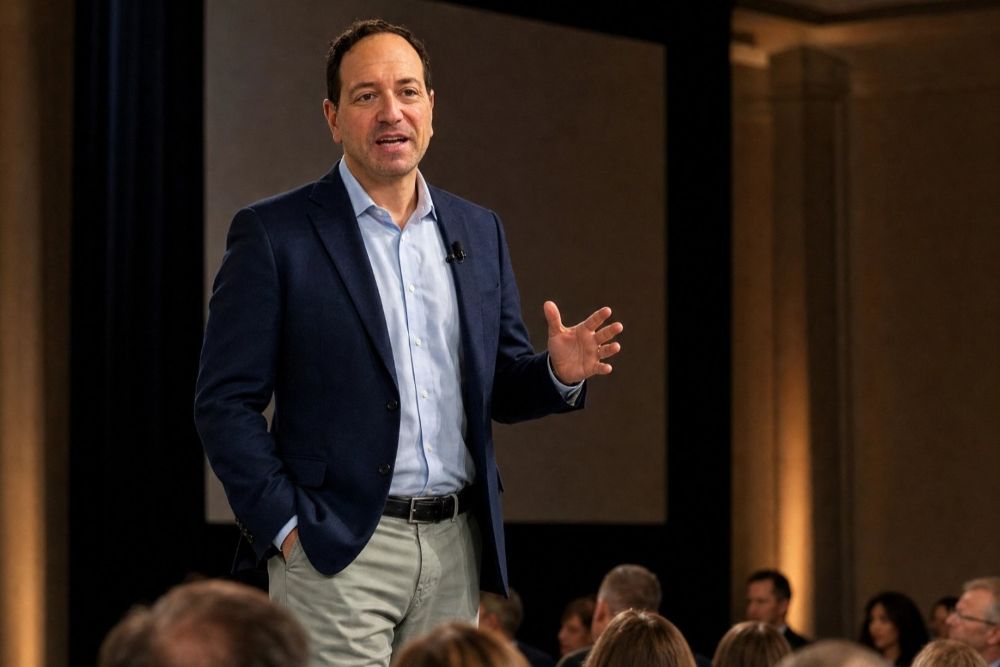

Forward Push Law Firm Marketing was founded in 2011 to solve what Founder Marc Apple calls the invisible excellence problem: skilled attorneys losing cases to inferior competitors who simply had better marketing.
Before that, he spent years in senior marketing leadership at CBS Radio and Clear Channel, then founded a startup in San Francisco built to help creative professionals present and market their own work.
“When I turned my attention to law, I saw the identical pattern I had seen with creatives: attorneys with real skill and real reputations, represented online through generic, disconnected marketing that undersold what they actually did,” Apple says. “Forward Push was built to close that gap.”
Since that time, his team has built real wins for clients. “Firms now show up where they didn’t before,” Apple says. “But that broader mission is ongoing. Most attorneys are still invisible in at least one place that matters to their next client. That’s the gap we get up every day to close.”
AALM: Tell us about your team and how you’re different from other agencies.
MA: Forward Push runs lean by design, with a leadership team that works alongside a handful of employees who are specialists in a specific marketing tactic.
What separates us is that we don’t sell pieces. Most firms hire a website vendor, an SEO agency, an ads manager, and a video crew, and then wonder why none of it compounds.
We built 12 services and four AI components to run as one system instead: the content library feeds the video, the ads drive traffic to a site built to capture it, and every visitor who doesn’t convert gets followed up with automatically.
We only work with law firms doing $500,000 or more a year, and everything ties back to one number: signed cases, not clicks or impressions.
AALM: How has your company changed the most in the last 15 years? What’s stayed steady?
MA: What has changed is nearly everything about how a client finds a lawyer. It used to be referrals, the yellow pages, and showing up at the right bar association lunch.
Today a potential client is overwhelmed with more information than ever, and increasingly they’re asking AI directly who to call before they ever open a search engine.
What’s stayed steady is our focus on measuring ourselves by whether a client’s phone actually rings with the right kind of case, not by a report full of impressions.
Underneath every new tool, the fundamentals haven’t moved. A potential client still has to trust you before they call, and that trust still gets built through proof: real client outcomes, a real reputation, real visibility, not empty claims. The tactics for earning that trust have changed. The requirement hasn’t.
AALM: How have you stayed ahead of industry upheaval? Where’s your attention focused?
MA: My belief is that I must stay a student of the industry, permanently. I’m in masterminds with people running businesses in totally different industries, not just legal marketing, because I have found I can learn what they are doing and apply it here.
I go to conferences. I test things constantly instead of assuming what worked last week still works. And I ask why a lot: why a tactic worked, why a client responded the way they did, instead of just copying the result and hoping it holds somewhere else.
Where my attention actually goes is making sure we stay a people-first organization while we take AI seriously for what it’s actually good at, and honest about what it isn’t. AI can produce content and answer a phone at 2am. It can’t build the kind of trust that gets someone to pick up the phone in the first place. That’s still people. Our job is knowing exactly where that line sits and not pretending otherwise.
AALM: Looking ahead, what are your main focuses for clients? What’s shaping your outlook?
MA: We’re focused on a couple of things right now. First, closing the loop between marketing activity and actual signed cases and second, our proprietary system that handles a lot of the research and content production that used to take days, which lets us move faster for clients without cutting corners.
What’s shaping my outlook is pretty simple: the way a potential client finds a lawyer is splitting in two. Half of that decision still happens the old way, reputation, referral, a name someone remembers. The other half is starting to happen inside a conversation with an AI platform, before a human ever gets involved.
Firms that build real visibility into that AI-driven half of the decision now are going to own a position their competitors spend years trying to catch up to later, the same way firms that took Google seriously in 2012 had a decade-long head start on the ones who waited. The firms that wait for it to feel proven are the ones we’ll be talking about as case studies of what not to do.
AALM: Can you tell us about Case Gravity?
MA: Case Gravity is the system we built to solve one problem: most law firm marketing is a pile of disconnected tactics with no way to tell what’s actually producing business. It has four parts that work together.
Counsel Twin AI creates video using the attorney’s actual face and voice, so a firm can show up on camera consistently without pulling a lawyer out of billable work every week.
First Chair AI answers and qualifies calls after hours, so a firm stops losing cases simply because nobody picked up at 9pm.
Sidebar AI engages people who land on the website but don’t reach out right away.
Engage First brings back the visitors who left without converting.
We offer it in three tiers, Foundation, Authority, and Legacy, with ad spend kept separate so a firm always knows exactly what they’re paying for and why.
The whole system is built around one constraint: less than 24 minutes of the attorney’s time per month. Attorneys practice law. We make sure the right people find them.
AALM: Can you share a best first step for law firm leaders looking to grow their firm (beyond hiring your agency)?
MA: Before anything else, look at your own numbers honestly. Most firm owners can tell you their win rate in the courtroom, but they can’t tell you how many calls came in last month, how many turned into signed cases, or where those calls actually came from.
That’s the first step, and it costs nothing. Start tracking it yourself, even in a spreadsheet. Once you can see the gap between what’s coming in and what’s turning into business, you know exactly where the problem actually is instead of guessing.
A lot of firm owners assume their problem is visibility. Sometimes it is. Just as often it’s intake, or follow-up, or a website that doesn’t do anything once someone lands on it. You can’t fix what you haven’t measured.
AALM: Can you tell us about one or two of your best client case studies.
MA: Two come to mind. Pete Chambers runs a family law practice in Atlanta with a specific niche: divorce cases where addiction is a factor. That kind of specificity needed precision, not a generic template. We built positioning and content around exactly that situation.
Over half of the firm’s new visitors now find them through organic search, meaning they do not need to invest as much in ads as they once did. They’ve became a recognized resource in Atlanta for addiction-related divorce and recently won the Best of Buckhead award.
The other is Sammy Kim, a bilingual tax controversy attorney based in Virginia. We built a sustained content strategy around the exact questions her clients ask: IRS notices, penalty abatement, foreign compliance, crypto tax issues. Her name now surfaces when people ask ChatGPT, Claude, or Gemini for an IRS attorney, and her client list includes individuals from across the country. The best part is her clients arrive at their consultation already having validated her through her Counsel Twin AI videos and her social media before they ever call.
AALM: You’ve written best-selling legal marketing books. What compelled you to write them? Are you working on any new projects?
MA: I’m proud to say that both “The Legal Marketing Playbook: Proven Strategies to Attract, Engage, and Retain Clients” and “Too Busy to Market? The AI Playbook for Lawyers” are number one Amazon bestsellers in the legal marketing category and are featured titles in the State Bar of Georgia library.
I wrote them because I got tired of watching good attorneys get bad advice. Most of what passes for legal marketing guidance is outdated or sold by someone with a product to move. I wanted something an attorney could trust and act on without a sales pitch attached to every page.
I’m working on a new series now, one book per practice area instead of one general playbook. Family law, personal injury, tax, immigration, each has its own version of the invisible excellence problem, and a generic answer doesn’t serve any of them well. I haven’t landed on the exact list of topics yet.
If anyone reading this wants a copy of either book email me and I’ll get one to you.
AALM: Anything else you’d like to add?
MA: Success is a duty, not a goal. That’s the idea underneath everything at Forward Push. Marketing shouldn’t be a random activity. It should create compounding authority, real trust, and outcomes a firm can actually measure.
If a firm takes our advice and their result isn’t there, that’s not a case of a failed aspiration. It’s an obligation that we haven’t met. Yet.