
Your Google rankings don’t mean what they used to. If your firm has invested in SEO over the past decade, you probably built your strategy around one goal: rank at the top of Google for relevant search terms
That strategy worked. A top organic position meant a steady stream of prospective clients finding your website, reading your content, and picking up the phone.
Here’s what the data says now.
Roughly 78% of legal search queries now trigger AI Overviews, the AI-generated summaries Google places at the very top of search results. That’s the highest trigger rate of any industry vertical.
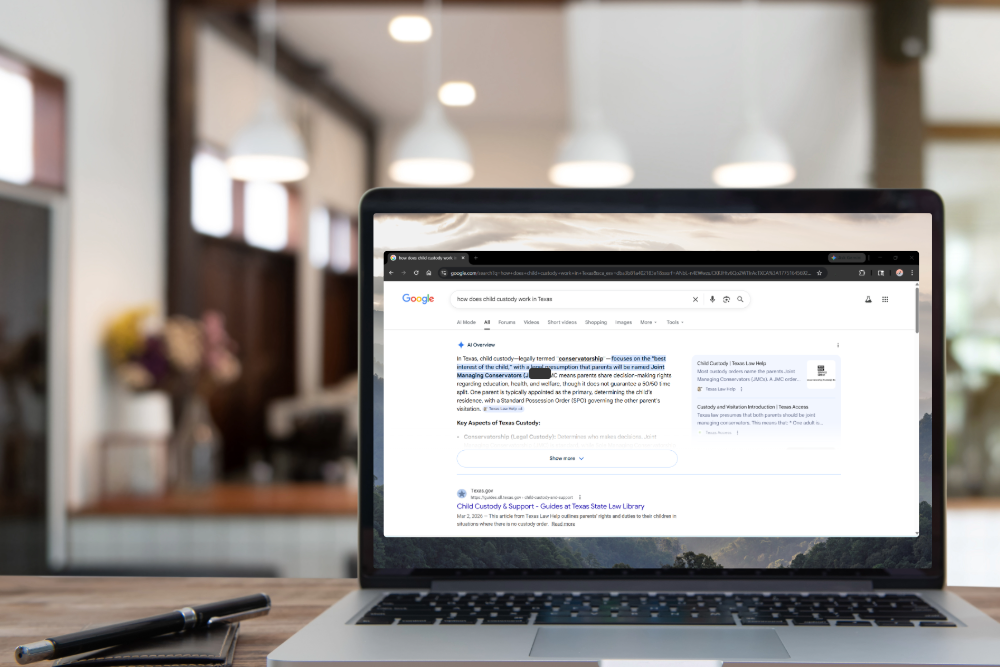
When a prospective client Googles “what to do after a car accident” or “how does child custody work in Texas,” they’re not seeing your website first anymore. They’re seeing Google’s AI-synthesized answer, pulled from sources Google’s system considers most authoritative.
The traffic impact is quantifiable. An Ahrefs study published in February 2026 found that AI Overviews reduce click-through rates to the number one organic result by 58%. In April 2025, the same researchers measured 34.5%. The number nearly doubled in eight months. Between 60% and 69% of searches with AI Overviews now end without a single click to any website. Your firm might still be ranking. People just aren’t clicking through.
In a previous article for this publication, I covered how platforms like ChatGPT represent a new search channel. Google’s AI Overviews are a different issue. They’re not a separate channel. They’re reshaping the one you already depend on.
What AI Overviews Are and Why Legal Is Disproportionately Affected
For those of you who haven’t seen this firsthand, here’s how it works.
Someone types a legal question into Google. Instead of showing you ten blue links, Google’s AI generates a summary answer at the top of the page with cited sources below it. That summary appears above all your organic results and often answers the question well enough that nobody scrolls down. In many cases, these overviews take up so much real estate that users have to scroll down before getting to the sponsored result – not to mention the first organic result.
Google’s AI generated summary appears above all the organic results and answers the question well enough that nobody scrolls down. In many cases, these overviews take up so much real estate that users have to scroll down before getting to the sponsored result – not to mention the first organic result.
This isn’t ChatGPT or Claude. This is Google itself. The platform your firm has spent years and real money optimizing for. The data shows the rules have shifted.
Legal queries trigger AI overviews more often than other types of queries, and the reason is straightforward: they’re exactly the type AI Overviews are designed for. Informational and detailed enough to benefit from a synthesized answer.
Importantly, Google has recently made links more visible within AI Overviews. When your firm is cited as a source, users can navigate directly to your page without leaving the AI experience. This makes visibility in these overviews increasingly valuable, not just for brand exposure but as a direct traffic channel.
What Gets Cited and What Gets Ignored
There’s significant overlap between traditional rankings and AI Overview citations. Over 92% of citations come from domains already ranking in the top 10 organic results. SEO still matters. But ranking alone isn’t enough anymore.
In my 13 years running Lexicon, I’ve reviewed thousands of law firm websites. The pattern is consistent. The content that gets cited in AI Overviews shares specific characteristics that most firm websites lack. Here’s what I’m seeing.
Direct answers to specific questions – Content that opens with a clear response to a legal question gets cited. Content that buries the answer under 500 words of firm marketing doesn’t. I see this constantly: practice area pages that start with three paragraphs about how the attorneys are “dedicated to fighting for your rights” before getting to the actual information. Google’s AI skips right past that.
Verifiable authority signals – Attorney credentials, bar admissions, years of practice area experience. Not “our firm has decades of experience” but actual named professionals with identifiable qualifications. Google’s E-E-A-T framework has always rewarded this. AI Overviews have made it a gating factor.
Jurisdiction-specific detail – Statutes, filing deadlines, state-specific procedures. Generic legal information that could apply anywhere gets passed over. A page that references the actual statute number and explains what it means in practical terms outperforms a page offering general advice.
Structured, scannable formatting – Question-based headers, clear sections, FAQ formats. AI systems need to extract a coherent answer from your page, and they don’t do well with content that meanders across topics without clear organization.
Freshness – A practice area page last updated in 2022 is competing against pages reflecting 2025 statutory amendments. The outdated page loses. Every time.
Here’s what gets ignored: sales copy disguised as educational content.
Thin pages that say “contact us to learn more” instead of answering the question. AI-generated content without genuine legal review – and yes, Google is getting better at identifying that.
Duplicate or templated pages with city names swapped in. If your firm has 30 location pages that are essentially the same content with different city names, AI Overviews won’t cite any of them.
The Business Case for Acting Now
The data is clear: organic website traffic is declining because of AI-powered search.. Meanwhile, personal injury lawyers are paying up to 568% more per click than they were in 2021, according to iLawyer Marketing data. Some legal keywords now exceed $1,000 per click.
Do the math with me. If your organic traffic dropped 19% but your intake conversion rate stayed the same, you lost roughly one in five potential cases that would have come through your website.
For a personal injury firm with a $50,000 average case value handling 100 organic leads annually, that’s 19 fewer cases and nearly a million dollars in unrealized revenue.
Here’s the thing I keep telling firms: this isn’t a technology problem that requires a massive budget. It’s a content quality problem. The firms earning AI Overview citations don’t necessarily have bigger marketing departments. Many are working with legal writers who can translate attorney expertise into the structured, authoritative content Google’s AI actually cites.
A Practical Starting Point
I’m not going to hand you a 47-step implementation framework. Here’s what I tell every lawyer who asks me where to start.
Run The Test Yourself
Google your top five practice area questions, the ones prospective clients actually ask during consultations. Look at what appears in the AI Overview. Are you cited? Are your competitors? This takes 15 minutes and tells you exactly where you stand.
Audit Your Top Ten Practice Area Pages
For each page, ask three questions. Does it directly answer a specific legal question within the first 100 words? Does it include jurisdiction-specific statutes and procedures? Is a named attorney’s credentials attached? If any answer is no, that page isn’t positioned for AI Overview citations.
Prioritize Depth Over Volume
One thorough, attorney-reviewed page on “what to do after a DUI in your state” that includes statutes, timelines, penalties, and procedural steps will outperform 10 thin blog posts on tangentially related topics. AI Overviews reward comprehensive answers. I’d rather see a firm publish one excellent page a month than four mediocre ones a week.
Update Your Most Important Pages Quarterly
Freshness is a documented citation signal. When statutes change, when case law develops, when filing procedures are updated, your content should reflect that. A quarterly review of your top practice area pages is a reasonable minimum.
The Data Points in One Direction
Most firms are still optimizing exclusively for traditional organic rankings. That strategy is producing measurably lower returns each quarter. Google isn’t scaling back AI Overviews. The feature has expanded to over 200 countries and more than 40 languages since May 2025. Google has also launched AI Mode, where 93% of searches end without a click to any external website.
The firms adapting now are building authority signals that compound over time. The data is consistent across every study published in the past 12 months: AI Overviews aren’t a temporary experiment. They’re how Google works now.
Roughly 78% of legal searches already trigger an AI Overview. Your prospective clients are seeing AI-generated answers to their legal questions today. The evidence says this is only expanding. The question is whether your firm will be among the sources being cited.