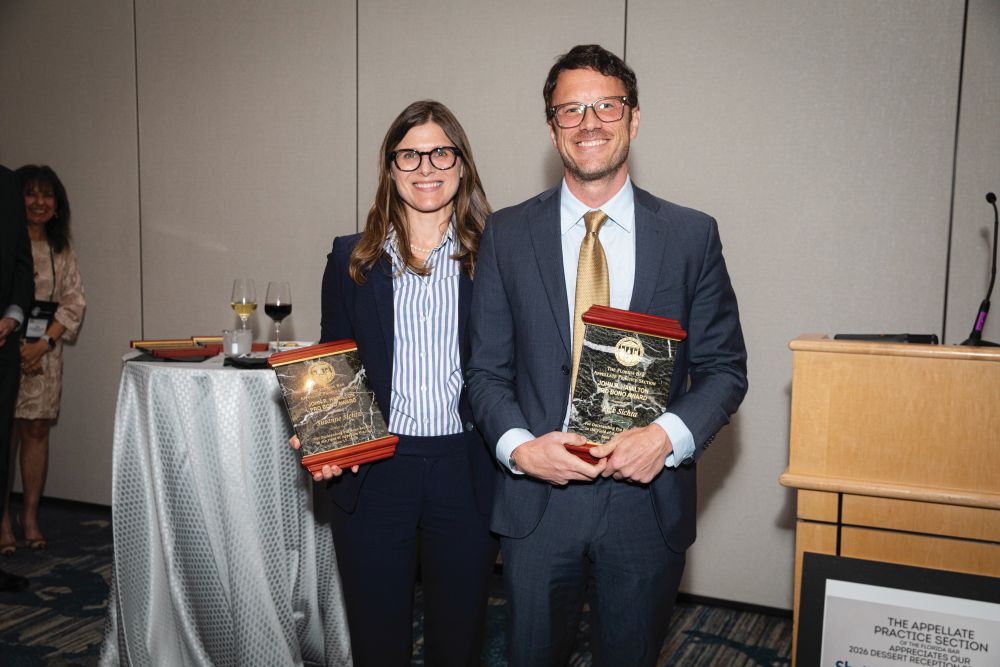

Susanne and Rick Sichta were presented with the 2026 John R. Hamilton Pro Bono Award of the Year by the Florida Bar’s Appellate Practice Section. This award honors members who have demonstrated extraordinary commitment to expanding access to justice through pro bono appellate work. The Section noted the Sichtas’ long-term track record of providing pro bono assistance to criminal defendants, their work with the Florida Coastal Law Clinic, and their efforts to recruit other attorneys to pro bono work through a free legal online service they run.
“Obviously, we are honored and touched to be seen by the Bar and The Appellate Section, and the appellate judge who nominated us,” Rick Sichta said. “It was a complete shock to be recognized. Susanne and I had no idea the Bar and the Appellate Section knew what we were doing because it’s not something we advertise or boast about. It’s a service that simply must be done. It felt really special to be recognized for helping those in need.”
AALM: Tell us what first drew you to take on pro bono work.
RS and SS: Pro bono work is necessary for anyone holding a law license, in our opinion. A Bar card allows one to change lives, and that is our focus. Coming from a rural blue-collar town in Northern Wisconsin, we understand that many people cannot afford a lawyer. So, when we get a call from such an individual, and we believe in them and their case, we are going to take the case. Some of our pro bono representations last a few weeks, others over a decade. Currently, we are working with Skaddon, Arps, Slate, Meagher & Flom LLP for a client we were able to remove from death row in 2010. We strongly believe in his innocence, so the work continues.
AALM: Do you recall your first pro bono case?
RS: The first case I worked on was for a man doing 27 years in prison for stealing a diamond from a pawn shop. In prison, he was a leader, educating inmates and providing them with hope in dark times. Ultimately, his sentence was reduced to three years. After his release, he created a re-entry program for inmates being reintroduced into society, providing them with jobs and connections for a successful transition. President Bill Clinton even wrote about him in his book, “Giving.” I have a signed copy from the president on my bookshelf in my office.
AALM: Tell us a bit about the Rich Midkiff case?
RS: During his more than two decades in DOC custody, Rich Midkiff developed a reputation as a “model” of rehabilitation and leadership. He became a certified law clerk and inmate paralegal, assisting hundreds of incarcerated people and their families. He also founded programs like Story Time Dads (incarcerated parents recording themselves reading children’s books for their kids) and the SAGE personal development program.
He had been released from prison, but an appellate decision essentially held that the lower court’s decision to let him go free was incorrect. He was supposed to go back to prison for another 15 years.
Through a mutual connection, I became the attorney of record along with two others working on a pro bono basis. Fortunately, the lower court and prosecutor agreed this was an injustice. We were able to keep Rich from going back to prison. Since that time, he has proven it was the right decision.
AALM: Tell us about your work with law school students.
RS: I was honored by Florida Coastal School of Law to teach the inaugural wrongful convictions law clinic. I would teach appellate law, and with the assistance of students, work on real-life pro bono cases. In our second year, we ended up exonerating a man serving a 40-year sentence.
AALM: Tell us about your Legal Questions Answered Group.
RS and SS: Over a decade ago, we started a “Legal Questions Answered” Group, devoted to finding attorneys who were willing to offer their knowledge to individuals faced with the daunting task of navigating our legal system. Today, we have over 123,000 members across the world.