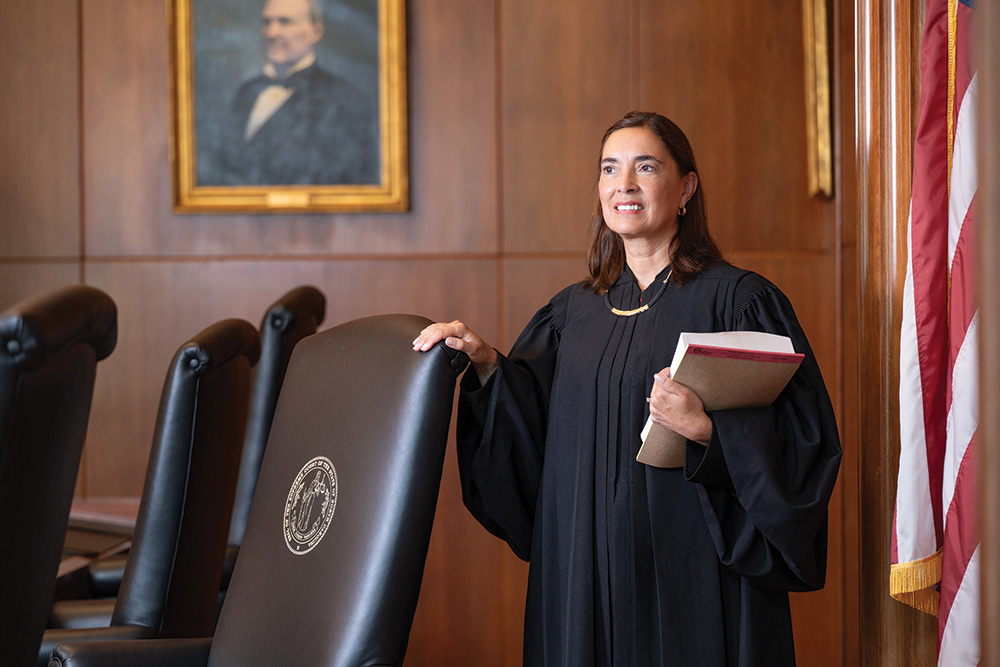

“There are so many aspects of daily life in North Carolina that are impacted by decisions of our court, and voters hold the power to decide ultimately who should be making those decisions, and that’s just fundamental to democracy,” said North Carolina Supreme Court Associate Justice Anita Earls, who is running for re-election as a Democrat.
“[It’s] people who are injured on the job seeking fair compensation for their injuries, it’s people seeking to access medical care, it’s folks who want to protect our environment and make sure we have clean air and clean water and protect our wildlife, and it’s people who want to see their children get a sound, basic education.”
Civil Rights Career
Earls grew up in Seattle. Her parents had moved there from Missouri due to its laws banning interracial marriage. Her mother is white and her father is black. She and her brother were both adopted.
After graduating from Yale Law School in 1987, Earls practiced civil rights law in both private practice and public service roles. Prior to her election to the SCONC in 2018, she served as the executive director of the Southern Coalition for Social Justice (SCSJ), as well as a deputy assistant attorney general in the civil rights division of the U.S. Department of Justice during the Clinton administration.
While at the SCSJ, Earls represented clients in voting rights lawsuits, including serving as lead plaintiffs’ attorney in North Carolina v. Covington, a landmark U.S. Supreme Court case that resulted in 28 of North Carolina’s state House and Senate districts being declared unconstitutionally racially gerrymandered. A federal court then ordered a special master to redraw the districts for the 2018 election. That year, Democrats broke the legislature’s nearly decade-long Republican supermajority.
In 2022, after new districts were drawn following the 2020 census, Earls voted with the court’s majority that ruled extreme partisan gerrymandering violates voters’ rights under the North Carolina Constitution.
“I’m proud to be a part of that majority because I think that the question is: is our democracy structured in a way that is fair to all voters, regardless of which political party they belong to, or for unaffiliated voters, how they actually vote when they go to the ballot box?” said Earls. “What matters is how they vote. Are their preferences accurately reflected in the governing body that results? And I believe that that decision would have given North Carolina a robust democracy that actually reflects the will of the voters.”
In 2023, the Republican majority on the court ruled 5-2 that it is beyond the authority of the judicial branch to address partisan gerrymandering claims, clearing the way for state Republicans to redraw congressional districts.
Right to Education
Earlier this year, the SCONC ended the 32-year-old Leandro litigation that originally sought to increase state funding for public schools in five lower income counties. In 1997, the court unanimously declared that the state constitution guarantees every child the right to a “sound, basic education.” The General Assembly was ordered to provide an additional $677 million in public school spending. This year’s ruling struck down that mandate.
“I think public education is a core value of our state constitution,” said Earls. “When the court issued a final ruling in the Leandro case, it turned its back on our constitutional duty to ensure every child in North Carolina is offered a sound, basic public education. A trial court found that our children are not receiving this constitutional minimum. With the decision to end the Leandro case and any possibility of relief for the plaintiffs, the immediate future of public education funding in North Carolina will not include the money the court ordered to be spent.
“The right to a sound, basic education under the state constitution is fundamental to our children’s future, to our communities, to our families, to our economy and to our democracy.”
Threat to Judicial Independence
In a 2018 survey by the National Judicial College, 90 percent of judges polled said judicial independence is threatened. Earls concurs.
“My own sense just from my experience on the bench is that it’s really the legislature that poses the greatest threat to judicial independence through their ability to threaten to impeach judges, through their changes in the Judicial Standards Commission, and the ways that the legislature has impacted issues of judicial administration,” said Earls.
“I hope that by shining a light on how I think that occurs, ultimately the voters decide who sits on our court. We need to find jurists who are willing to have the backbone to carry out our constitutional role of enforcing the state constitution and not showing fear or favor to any party. That is in the oath that we take when we’re sworn in. We swear not to favor the government or any other party, and we swear to apply the law equally without any distinctions or bias.”
“In the Leandro case and the cases that have dealt with redistricting, in particular partisan gerrymandering and issues of whether a voter ID law is intentionally racially discriminatory, I have said in my dissenting opinions, that I think the court is failing to live up to its responsibility to hold the General Assembly and hold the state government accountable to the state constitution.”
Increased Utility Rates
Earlier this year, the SCONC upheld the NC Utilities Commission’s 2023 decision to allow Duke Energy to raise rates over the course of three years. Earls had voted to reject the increase. “Duke Energy will charge consumers in the western part of the state more than consumers in the eastern part of the state for identical electrical services,” wrote Earls in her dissenting opinion.
“It raised electricity rates in order to give shareholders a higher rate of return on their investment at a time when shareholders were seeing record profits and consumers are increasingly having trouble paying their electric bills,” said Earls. “And that’s not what state law requires. State law says that the rate should be set at the lowest reasonable rate taking into consideration the needs of consumers.”
Two-Way Street
On the campaign trail, Earls is communicating that she faces the same day-to-day challenges as voters. “It’s a two-way street. The campaign process should both allow voters to get to know me as a person, but also allow me to get to know a little bit more about what the people of the state are facing. What folks in the mountains are facing right now is different than northeastern North Carolina. Although, at the end of the day, people are struggling to make a living. But the nature of the barriers they’re facing, and the hurdles they have to overcome might be different. And that knowledge, I think, should inform how we rule in our cases.”
Part of that two-way street was Earls’ public disclosure earlier this year about her diagnosis for breast cancer in 2025. “I was surprised to learn how many women in North Carolina don’t understand the importance of or sometimes are afraid of getting breast cancer screening.”
Everyone’s Voice
The November mid-term elections are creating a lot of heat and light around seats in the U.S. House and Senate leaving down-ballot races somewhat in the shadows. However, excessive out-of-state funding is expected to be spent on the SCONC election. Earls is urging voters to learn about judicial candidates before they go to the polls.
“I just strongly believe that we should make it possible for every qualified voter to cast a ballot and have that ballot counted, and it’s just so important that everyone’s voice gets heard,” said Earls.
“Lawyers have an incredibly important role in spreading information about our court system, about what they think matters, and just across the board, I would urge attorneys to see it as part of their professional obligation to be civically engaged, no matter who they support or how they view the issues.
For more information, visit earls4justice.com or email [email protected].