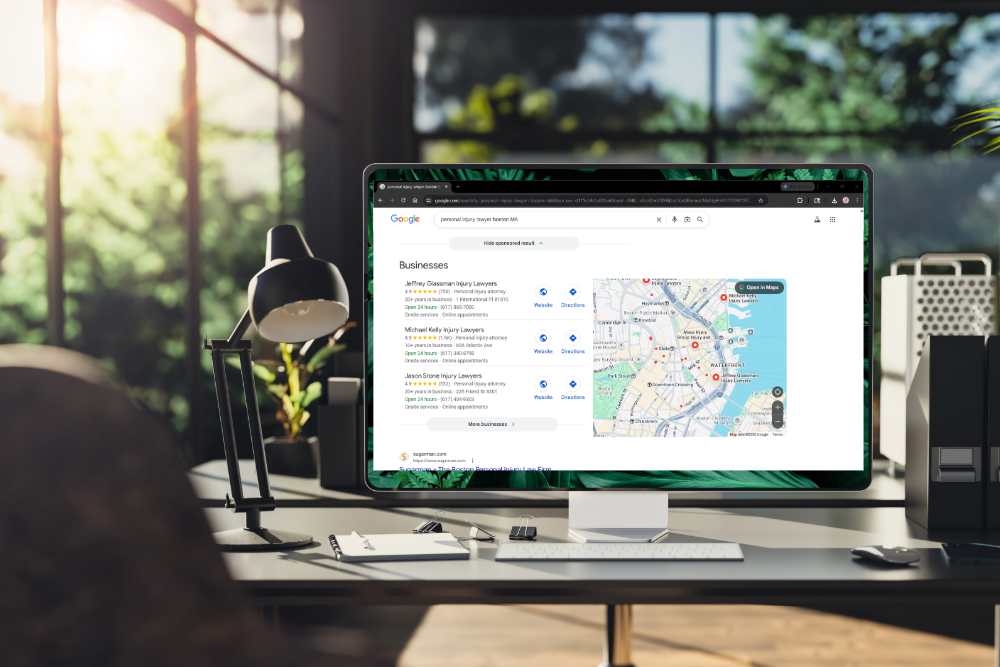

Local SEO for law firms is no longer a “nice to have” as competition has skyrocketed in recent years. It is often the deciding factor in whether a prospective client calls your firm or your competitor.
Google Business Profile (formerly Google My Business) sits at the center of this decision-making process. It appears before most websites, dominates mobile search results, and captures users at the exact moment they are searching for legal help. Yet despite its importance, many law firms still treat it as a static listing rather than a strategic growth asset.
This article explores advanced Google Business Profile optimization strategies for law firms, grounded in real-world case studies and proven execution. The goal is to help firms understand why certain tactics work, how Google evaluates local authority, and what steps actually move rankings, calls, and cases.
Why Google Business Profile Dominates Local Search for Law Firms
When someone searches for a lawyer, the intent is usually immediate. Unlike informational searches, legal queries often signal urgency, an accident, a dispute, an arrest, or a critical legal decision. Google understands this behavior and prioritizes results that reduce friction between the searcher and a trusted local firm.
That is why Google Business Profile occupies so much real estate in legal search results.
On both desktop and mobile, Google Maps listings frequently appear above organic website results. For many practice areas, the Map Pack is the first and sometimes only set of options users seriously consider. Phone calls, directions, and website clicks can all happen directly from the listing, without a user ever scrolling further down the page.
This dynamic explains why law firms can rank well organically yet still struggle to generate calls if their Google Business Profile is weak or poorly optimized.
High-Intent Visibility Beats Passive Traffic
Google Business Profile does not just drive traffic; it drives decision-ready prospects. Users interacting with Maps listings are often closer to contacting a firm than those reading blog content or browsing general search results.
From Google’s perspective, this makes accuracy, trust, and engagement critical. The platform prioritizes listings that demonstrate:
- Clear relevance to the search query
- Verified, consistent business information
- Signs of legitimacy and authority
- Strong user interaction and responsiveness
Firms that fail to send these signals are often pushed below competitors, even if their websites are otherwise well-built.
A Common Pattern in Underperforming Law Firms
One of the most common situations we see involves firms that appear “almost visible.” They rank just outside the top three map results for high-value keywords like litigation lawyer + city or personal injury attorney near me. Traffic exists, but call volume remains inconsistent.
In one litigation-focused case, the firm was stuck outside the top 10 map results despite years in practice and a solid reputation. The issue was not a lack of demand. Instead, the Google Business Profile itself was working against them, with the wrong primary category, thin service descriptions, and little ongoing activity.
Once these structural issues were addressed, the firm moved into the top positions on Google Maps and began receiving a noticeable increase in calls and new matters. The takeaway is simple: visibility is not just about presence, but about alignment with how Google evaluates local legal businesses.
Why This Matters for the Rest of the Strategy
Understanding the dominance of Google Business Profile in local legal search sets the foundation for everything that follows. Advanced optimization is not about chasing shortcuts or exploiting loopholes. It is about aligning your firm’s digital presence with the signals Google already trusts most when deciding which law firms to show first.
From Visibility to Authority: How Google Evaluates Law Firms Locally
Ranking in Google Maps is not simply a matter of being nearby. While proximity plays a role, it is rarely the deciding factor in competitive legal markets. Google’s primary challenge is not showing a law firm, but showing the most reliable law firm for a specific search.
To make that determination, Google evaluates local law firms through a combination of relevance, authority, and trust signals, many of which extend far beyond the Google Business Profile itself.
Relevance Is Earned Through Clarity, Not Keywords
Relevance refers to how well your firm matches the intent behind a search. For legal queries, this is largely driven by practice area alignment.
Google examines whether your business category, services, website content, and profile descriptions clearly indicate that you handle the type of legal issue being searched. When these elements are vague, inconsistent, or overly broad, relevance weakens even if your firm technically offers the service.
This is why firms that describe themselves generically as a “law firm” often struggle to rank for high-value practice-area searches. Google prefers specificity. A firm that clearly presents itself as a divorce-focused practice or a personal injury firm sends a much stronger relevance signal than one that tries to cover everything at once.
In the litigation firm case referenced earlier, relevance was the first major obstacle. The firm’s primary category did not reflect its core litigation work, and services were thinly defined. Once the profile was rebuilt around the firm’s actual focus, Google began treating it as a better match for litigation-related searches.
Authority Is the Differentiator in Competitive Markets
Authority is where many law firms plateau.
Google uses authority signals to determine which firms deserve prominent placement when multiple businesses appear equally relevant and nearby. These signals are cumulative and are built over time, not added in a single optimization session.
For law firms, authority is shaped by:
- Consistent business information across the web.
- Quality and frequency of reviews.
- Engagement with the Google Business Profile.
- Alignment between the profile and the firm’s website.
- Mentions and links from credible external sources.
When these signals reinforce one another, Google gains confidence in promoting the firm. When they conflict, rankings become unstable.
This dynamic was evident in the Yegendorf Rashid case. Despite being a well-known firm offline, their online authority was fragmented due to duplicate websites and scattered signals. Consolidating their digital footprint and aligning messaging restored Google’s confidence and unlocked sustained growth in visibility.
Trust Is Validated Through Verification and Behavior
Trust is not abstract in Google’s algorithm. It is validated through confirmation and behavior.
Verification ensures that a business exists where it claims to exist and operates under a legitimate identity. Engagement, such as calls, direction requests, review interactions, and profile activity, demonstrates that users find the listing useful.
Law firms with verified, actively managed profiles tend to outperform those that appear static or incomplete. Even small signals, such as timely responses to reviews or consistent posting activity, contribute to an overall pattern of reliability.
Importantly, trust is fragile. Inaccurate information, unresolved duplicates, or long periods of inactivity can erode it quietly, without obvious warnings.
Why Authority Explains Ranking Volatility
Many law firms experience fluctuations in Google Maps rankings and assume an algorithm update is to blame. In reality, volatility often reflects weak or inconsistent authority signals rather than external changes.
Firms that rely on proximity or temporary engagement spikes may appear briefly, then disappear. Firms that invest in authority through structure, consistency, and ongoing optimization tend to hold their positions even as competitors come and go.
Understanding this distinction is critical. It shifts the focus from chasing tactics to building a durable local presence.
Building a Strong Google Business Profile Foundation for Law Firms
Before advanced optimization can produce results, the underlying structure of a Google Business Profile must be correct. Many law firms attempt to layer tactics, such as reviews, posts, and photos, on top of a weak foundation. When rankings fail to improve, the issue is rarely effort; it is structural misalignment.
Google Business Profile is not forgiving when it comes to setup errors. Decisions made at this stage influence how Google classifies, evaluates, and ultimately ranks your firm for years.
Creating and Claiming Your Google Business Profile Correctly
Creating a Google Business Profile is straightforward on the surface, but the way information is entered has long-term consequences.
The business name should reflect the firm’s real-world branding exactly as it appears on signage, legal documents, and the website. Adding keywords or descriptors may seem like a shortcut, but it introduces risk and weakens trust signals over time. Google increasingly relies on user edits, external data sources, and automated checks to enforce naming consistency.
Category selection is even more critical. The primary category tells Google what type of legal services your firm should be shown for. When this category does not reflect your highest-value practice area, your profile becomes less competitive by default.
This issue was central to the litigation law firm case referenced earlier. The firm had the experience, credentials, and demand to rank, but its primary category did not align with litigation-focused searches. Rebuilding the category structure immediately improved relevance and opened the door to Map Pack visibility.
Beyond categories, firms should ensure that:
- The physical address is accurate and formatted consistently.
- Phone numbers match those used on the website and legal directories.
- Service areas reflect where clients are actually served.
- Office details are complete and current.
Once the listing is created, claiming and managing it is essential. An unclaimed profile limits control and allows third parties to suggest edits that may not reflect the firm accurately.
Google Business Profile Verification and Why It Matters
Verification is Google’s way of confirming that a business is legitimate and operational. Until verification is complete, a profile operates at a disadvantage.
Google offers several verification methods depending on the firm’s history and online presence. These may include phone verification, postcard verification, email verification, video verification, instant verification through connected Google services, or bulk verification for firms with multiple locations.
While the method itself is not a ranking factor, verification unlocks functionality that directly affects performance. Verified profiles gain full access to reviews, posts, messaging, insights, and profile edits, which play a role in engagement and trust.
In more complex cases, such as firms with multiple domains or prior ownership issues, verification also helps establish a single authoritative version of the business. This was a necessary step in the Yegendorf Rashid campaign, where consolidating assets and confirming ownership helped eliminate ambiguity in Google’s understanding of the firm.
Why Verifying Your Listing Protects Rankings Long-Term
Verification does more than enable features. It protects the profile.
Unverified or poorly managed listings are more vulnerable to incorrect edits, spam, and duplication. Competitors, users, or automated systems may suggest changes that alter categories, hours, or even addresses. Over time, these inaccuracies can quietly erode trust and suppress visibility.
A verified, actively managed profile allows law firms to:
- Control how the business is represented.
- Respond quickly to changes or errors.
- Maintain consistency across Google’s ecosystem.
- Signal professionalism and legitimacy.
From Google’s perspective, this level of control reduces risk. Profiles that appear stable and well-managed are safer to show prominently, particularly for searches involving sensitive legal matters.
Establishing this foundation does not produce instant rankings on its own, but it removes barriers that prevent progress later. Without it, advanced optimization efforts often fail to reach their full potential.
With the foundation in place, the next step is leveraging Google Business Profile’s built-in features to improve engagement, relevance, and conversion.
Using Google Business Profile Features to Drive Calls and Cases
Once a Google Business Profile is properly structured and verified, the focus shifts from eligibility to performance. This is where many law firms stop short. They complete the setup, add a few photos, and expect rankings and calls to follow automatically.
In reality, Google treats active, well-utilized profiles very differently from static ones. Features such as posts, messaging, visuals, and questions are not cosmetic additions. They are engagement signals that help Google evaluate how useful and trustworthy a listing is for real users.
When used strategically, these features improve rankings and influence whether a prospective client chooses to contact your firm.
Google Business Profile Posts as a Relevance Signal
Google Business Profile posts function like short-lived content updates that reinforce what your firm does and who it serves. While posts expire after a short period, their impact compounds when published consistently.
For law firms, posts work best when they mirror the types of questions and concerns potential clients are already searching for. Short explanations of practice areas, answers to frequently asked questions, and timely updates about the firm help Google associate your profile with specific legal topics.
In the litigation law firm case, posting became a turning point. After rebuilding the category structure and services, the firm began publishing weekly posts focused on common litigation questions. Over time, these posts reinforced topical relevance and contributed to a steady increase in visibility, ultimately helping the firm reach the second position in the Map Pack and generate more inbound calls.
The key is consistency. A profile that shows signs of ongoing activity appears more reliable to both users and Google than one that is updated sporadically.
Messaging, Calls, and Booking: Reducing Friction at the Moment of Intent
Legal searches are often urgent, especially on mobile devices. When a user clicks on a Google Business Profile, they are typically looking for a fast way to get answers or speak with someone.
Messaging and call features reduce friction at this moment of intent. When enabled and managed properly, they allow potential clients to reach out without navigating multiple pages or forms.
However, these features should only be activated if the firm can respond promptly. Slow or ignored messages can negatively affect user experience and engagement signals. From a strategic standpoint, responsiveness matters as much as availability.
For firms that can support it operationally, messaging and booking features often lead to higher-quality inquiries, as they capture prospects who are ready to take action rather than browse passively.
Visual Trust Signals: Photos and Videos for Law Firms
For legal services, trust begins visually. Before reading reviews or descriptions, users often glance at photos to assess professionalism and legitimacy.
Profiles with no photos or with low-quality, unrelated images tend to underperform. In some cases, Google may even pull images from third-party sources that do not accurately represent the firm.
High-performing law firm profiles typically include:
- Professional attorney headshots.
- Clear exterior and interior office photos.
- Team images that humanize the firm.
- Branding elements consistent with the website.
Videos, while optional, can further strengthen engagement. Short clips introducing attorneys or explaining what clients can expect during a consultation help reduce uncertainty and build familiarity.
In the Yegendorf Rashid campaign, updating visuals played a meaningful role in improving engagement. The refreshed imagery aligned with the firm’s modernized website and reinforced credibility, contributing to stronger interaction with the listing overall.
Google Business Profile Questions & Answers as Pre-Consultation Education
The Questions & Answers section is often overlooked, yet it serves a powerful purpose. It allows firms to address common concerns before a potential client ever picks up the phone.
When managed proactively, this section functions like a public-facing FAQ. Clear, well-written answers help users understand whether the firm is a good fit for their needs, which can improve lead quality and reduce unproductive inquiries.
It also sends a subtle authority signal. Firms that provide thoughtful, informative answers demonstrate expertise and attentiveness, qualities Google values when deciding which listings to surface.
Importantly, unanswered or inaccurate questions can work against a firm. Monitoring this section ensures that the information presented supports, not undermines, the firm’s positioning.
Engagement Signals That Compound Over Time
Individually, posts, messaging, visuals, and Q&A may seem minor. Together, they create a pattern of activity and usefulness that Google recognizes.
Profiles that show consistent engagement tend to:
- Attract more clicks and calls.
- Hold user attention longer.
- Generate better behavioral signals.
These outcomes reinforce rankings indirectly and improve conversion directly.
Advanced Authority Signals That Influence Google Maps Rankings
Once a Google Business Profile is properly structured and actively used, rankings often improve, but only to a point, and this is where many law firms encounter a plateau. They have optimized the visible elements of the profile, yet competitors continue to outrank them.
The reason is authority.
Google does not evaluate a law firm’s profile in isolation. Instead, it looks for confirmation across the broader web that the firm is established, credible, and trusted. In competitive legal markets, authority signals are often the deciding factor in who appears in the top map positions.
Local Citations and NAP Consistency
Local citations are mentions of your firm’s name, address, and phone number across third-party websites. While citations alone rarely propel a firm into top rankings, inconsistencies can quietly hold a firm back.
Google compares information from:
- Legal directories.
- Business listings.
- Professional associations.
- Social platforms.
When discrepancies appear, such as different phone numbers, address formats, or firm names, Google’s confidence decreases. Over time, this fragmentation weakens authority and limits visibility.
For law firms, the goal is not to be listed everywhere, but to be listed accurately where it matters. Legal directories, bar associations, and reputable business platforms carry far more weight than generic listings. Regular audits ensure that changes to office locations, phone systems, or branding do not introduce conflicting signals.
Website and Google Business Profile Alignment
One of the strongest authority signals comes from alignment between a law firm’s website and its Google Business Profile.
Google expects both assets to reinforce the same message:
- Practice areas listed on the website should match profile categories and services.
- Location information should be clearly visible and consistent.
- Content should reflect the firm’s actual focus and expertise.
When alignment is strong, Google can confidently associate the website with the local listing. When it is weak due to outdated content, vague messaging, or multiple conflicting domains, authority erodes.
This alignment challenge was evident in the Yegendorf Rashid case. Multiple versions of the firm’s website diluted trust and confused search engines. Once those assets were consolidated and optimized, both organic rankings and Google Maps visibility improved together.
Backlinks and Brand Mentions as Authority Validators
Backlinks remain one of the clearest indicators of authority in search. For law firms, quality matters far more than quantity.
Links from legal publications, industry associations, news outlets, and reputable blogs signal that the firm is recognized beyond its own website. Even unlinked brand mentions, where the firm is referenced without a clickable link, help reinforce legitimacy when they appear in credible contexts.
Strategically, this is where content marketing, public relations, and community involvement intersect with local SEO. Firms that publish thoughtful legal insights, contribute commentary, or engage with professional organizations naturally accumulate authority signals that support Google Maps rankings.
Behavioral Signals and Engagement Metrics
Beyond citations and links, Google evaluates how users interact with a firm’s listing. These behavioral signals provide real-world feedback about usefulness and relevance.
Key indicators include:
- Click-through rates from search results.
- Calls initiated from the profile.
- Requests for directions.
- Time spent engaging with profile content.
Listings that consistently attract interaction signal to Google that users find them valuable. Over time, this engagement reinforces visibility, particularly in competitive markets where proximity alone is not enough.
This is why conversion-focused optimization, clear descriptions, professional visuals, and responsive messaging play a role in rankings even though they may not appear technical on the surface.
Authority Is Built Through Consistency
Authority cannot be installed or toggled on. It is built through repeated, consistent signals that align across platforms.
Law firms that focus only on surface-level optimizations often see early gains followed by stagnation. Those who invest in alignment, credibility, and engagement tend to hold their positions even as competitors change tactics.
Understanding this distinction shifts expectations. Google Maps’ success is less about chasing algorithms and more about reinforcing trust at every touchpoint.
Common Google Business Profile Mistakes Law Firms Should Avoid
Many Google Business Profile issues do not stem from aggressive or unethical tactics. Instead, they emerge gradually as firms grow, relocate, rebrand, or work with multiple vendors over time. Because these problems rarely trigger clear warnings, they often go unnoticed until rankings stall or decline.
Preventing these mistakes is far easier and far less costly than repairing the damage later.
Over-Optimizing the Business Name
One of the most frequent mistakes law firms make is modifying the business name to include keywords. While it may seem logical to add phrases like “Personal Injury Lawyer” or “Litigation Attorney” to improve relevance, this approach often backfires.
Google expects the business name to match how the firm is represented in the real world. When discrepancies appear between the profile, website, signage, or legal records, trust weakens. In some cases, competitors or users may suggest edits that strip keywords entirely, causing sudden visibility drops.
The safest and most sustainable approach is strict consistency. Use the exact firm name everywhere and rely on categories, services, and content, not the business name, to communicate practice areas.
Leaving Listings Unclaimed or Partially Managed
An unclaimed or loosely managed profile limits what a law firm can control. Without full access, firms cannot properly respond to reviews, correct inaccuracies, or guide how the business is presented.
More importantly, inactivity sends the wrong signal. Profiles that appear neglected are more vulnerable to incorrect edits, outdated information, and loss of engagement. Over time, this can quietly suppress rankings even when the firm is otherwise reputable.
Active management is not about constant updates; it is about maintaining accuracy and responding promptly when changes occur.
Inconsistent Name, Address, and Phone Number Information
Google relies heavily on consistency to validate legitimacy. Even small discrepancies, such as variations in abbreviations, suite numbers, or phone formats, can introduce uncertainty.
For law firms, these inconsistencies often arise after:
- Office relocations
- Phone system changes
- Website redesigns
- Directory updates handled by different vendors
When Google encounters conflicting information across the web, it becomes less confident in which data is correct. That uncertainty can prevent a firm from achieving or maintaining top map positions.
Regular audits of the website, Google Business Profile, and key directories help prevent this issue from compounding over time.
Ignoring Reviews or Responding Poorly
Reviews are both a trust signal and a public representation of professionalism. Law firms that ignore reviews, positive or negative, miss an opportunity to reinforce credibility.
Equally damaging are responses that appear defensive, dismissive, or generic. Poorly handled responses can discourage potential clients and weaken engagement signals that influence local visibility.
A preventive approach focuses on:
- Responding to every review thoughtfully.
- Maintaining a calm, professional tone.
- Demonstrating accountability when concerns arise.
This approach not only protects rankings but also improves client perception long before the first consultation.
Overlooking Duplicate Listings and Incorrect Map Pins
Duplicate listings remain one of the most damaging issues for established law firms. Multiple profiles can split reviews, divide authority, and surface outdated information in search results.
Incorrect map pins create a different kind of problem. When users request directions and encounter confusion, engagement suffers. From Google’s perspective, poor user experience weakens trust signals.
Regularly checking Google Maps for duplicate profiles and verifying pin placement helps prevent these silent ranking suppressors from taking hold.
Prevention Is an Ongoing Responsibility
Most Google Business Profile issues are not dramatic. They develop slowly as details drift out of alignment. Firms that maintain strong local visibility are not those that optimize once and move on, but those that periodically review and refine their profiles.
By addressing small inconsistencies early, law firms protect the authority they have already built and create space for continued growth.
Ongoing Optimization and Performance Scaling
Google Business Profile optimization does not end once rankings improve. In competitive legal markets, visibility is maintained through consistency, responsiveness, and adaptation. Firms that treat optimization as an ongoing process tend to build momentum over time, while those that stop after initial gains often see their positions erode quietly.
Sustained performance depends on reinforcing authority and relevance as user behavior, competitors, and Google’s expectations evolve.
Review Strategy That Builds Authority Over Time
Reviews play a central role in both trust and visibility. However, the most effective review strategies focus on long-term patterns rather than short-term spikes.
Google looks for steady review acquisition, meaningful feedback, and active engagement. Reviews that mention specific services or experiences help reinforce relevance, while timely responses demonstrate professionalism.
In the litigation law firm case, reviews were initially sporadic and generic. After implementing a structured review request process and responding consistently, the profile began to reflect a clearer picture of the firm’s work. This shift coincided with improved map visibility and an increase in qualified calls.
From a strategic standpoint, reviews should be integrated into the client experience rather than treated as a marketing task. Firms that make review requests a natural part of case resolution tend to build stronger authority over time.
Posting Cadence and Profile Activity
Activity signals matter because Google favors businesses that appear engaged and current, particularly in fields where trust is essential.
Regular posting does not require volume or complexity. Short, focused updates addressing common legal questions or highlighting firm activity are often sufficient. What matters is consistency. Profiles that remain dormant for long periods risk losing relevance, even if the underlying information is accurate.
Posting also provides an opportunity to reinforce practice areas, address seasonal demand, and respond to changes in client behavior. Over time, this activity helps prevent stagnation and supports steady performance.
Using Google Business Profile Insights to Refine Strategy
Insights data provides valuable feedback on how users find and interact with your listing. While often underutilized, this information can guide strategic decisions.
Insights reveal:
- Whether users discover the firm through Search or Maps.
- Which queries trigger visibility.
- How often users call, request directions, or visit the website.
Patterns in this data help law firms understand which services generate interest and where optimization efforts should be focused. For example, if certain practice areas consistently drive engagement, those services may warrant additional emphasis in content, posts, or website alignment.
Used correctly, insights transform Google Business Profile from a static listing into a feedback loop for refining local visibility and lead quality.
How Google Business Profile Fits Into a Complete Law Firm SEO Strategy
One of the most common reasons Google Business Profile optimization underperforms is isolation. When treated as a standalone tactic, it can generate short-term visibility, but it rarely delivers lasting dominance in competitive legal markets.
High-performing law firms integrate Google Business Profile into a broader SEO and digital marketing strategy, one where every channel reinforces the same signals of relevance, authority, and trust.
Website SEO and Google Business Profile Must Reinforce Each Other
Google does not evaluate your Google Business Profile separately from your website. It cross-checks both to confirm that the firm it is showing users is legitimate, focused, and consistent.
From a technical perspective, this means:
- Practice areas emphasized on the website should match GBP categories and services.
- Location pages and contact information should align exactly with the profile.
- Internal linking should support core service pages tied to local intent.
Strategically, alignment ensures continuity for the user. When someone clicks from your Google Business Profile to your website, the experience should confirm what they expected to see. Clear messaging, relevant content, and intuitive navigation all contribute to stronger engagement, which are signals Google interprets as validation.
In the Yegendorf Rashid campaign, website consolidation and alignment were critical. Multiple domains and fragmented messaging diluted authority. Once those assets were unified, improvements in organic rankings and Google Maps visibility occurred together, reinforcing each other rather than competing.
Content Marketing as a Local Authority Engine
Google Business Profile posts are valuable, but they work best when supported by deeper content on the website.
Educational articles, practice area pages, and FAQs help Google understand:
- The scope of your legal expertise.
- The problems you solve for clients.
- The geographic areas you serve.
Well-structured content also becomes a natural source of authority signals. It earns backlinks, attracts brand mentions, and provides material that can be repurposed into GBP posts and Q&A responses.
From a strategic standpoint, content marketing transforms local SEO from a ranking exercise into a credibility-building process. Firms that consistently publish useful legal insights tend to see compounding benefits across search, Maps, and brand recognition.
Reputation Management Beyond Reviews
While Google reviews are a key component of local visibility, reputation management extends further.
Google also evaluates branded searches, mentions across the web, and overall engagement with your firm’s name. These signals indicate whether people actively seek out and interact with your brand.
Law firms that invest in the below areas often see increases in branded search demand and profile engagement, both of which support Google Business Profile performance indirectly.
- Clear communication with clients.
- Ethical review acquisition.
- Community involvement.
- Thought leadership.
Paid Search and Google Business Profile: Complementary, Not Competing
Paid advertising does not directly influence Google Maps rankings, but it can support them indirectly.
When paid campaigns increase brand exposure, they often lead to:
- More branded searches.
- Higher engagement with Google Business Profiles.
- Increased review opportunities.
These behaviors reinforce authority and trust signals over time. When coordinated properly, paid search and local SEO strengthen each other rather than operating in silos.
Why Integrated Strategies Produce Durable Results
The law firms that dominate local search over the long term are not chasing individual ranking factors. They are aligning messaging, experience, and authority across every digital touchpoint.
When Google Business Profile optimization is supported by the below assets local visibility becomes resilient rather than volatile.
- A fast, conversion-focused website.
- Clear practice area positioning.
- Ongoing content development.
- Active reputation management.
- Legitimate authority signals.
With all elements working together, rankings are less susceptible to fluctuations and competitive pressure.
Final Thoughts: Google Business Profile as a Competitive Advantage for Law Firms
For law firms, Google Business Profile is no longer a basic listing or a box to check during setup. It is one of the most influential decision points in the client acquisition journey, often determining which firm receives the call before a website is ever visited.
What separates firms that consistently dominate local search from those that fluctuate is not a single tactic or tool. It is how seriously they treat local visibility as a strategic asset.
The most successful firms understand that Google Business Profile optimization is cumulative. Rankings improve when relevance is clearly defined, authority is reinforced across the web, and engagement signals demonstrate real-world trust. When these elements align, visibility becomes stable rather than fragile.
Both case studies referenced throughout this article illustrate this principle. The litigation firm that recovered its rankings did not rely on shortcuts. Instead, it corrected foundational issues, clarified its services, built engagement through reviews and posts, and stayed active. Yegendorf Rashid’s growth followed a similar path, consolidating fragmented assets, strengthening authority, and reinforcing trust through consistency and quality.
These outcomes were not the result of isolated changes, but of deliberate alignment.
For law firms operating in competitive markets, the takeaway is clear: local search success is not about chasing algorithms. It is about presenting a clear, credible, and consistent signal of who you are, what you do, and why clients trust you.