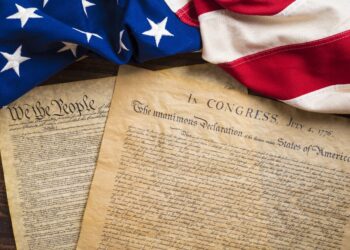

Two hundred and fifty years ago, our founding fathers pledged their Lives, Fortunes, and sacred Honor to protect the jury trial system. Among the grievances against the Crown set out in the Declaration of Independence justifying the colonies’ break from King George III, Thomas Jefferson included, “For depriving us in many cases, of the benefits of Trial by jury.”
By that time, jury trials had existed for more than 500 years, dating back to the signing of the Magna Carta by King John I in 1215. After King Henry VII’s successors abused his secret “Star Chamber” sessions to silence those who challenged their power, the British Bill of Rights renewed the guarantees of the Magna Carta, including trial by jury. When juries became a thorny tool of the American colonists to nullify oppressive British laws such as the Navigation Acts, restricting colonial imports and exports to only British ships, the Crown eliminated jury trials and their challenges to British authority.
This proved too much for Jefferson and his fellow founding fathers. Knowing they were putting themselves on a path to war against the world’s greatest power, they absolved their allegiance to the Crown and set out to create a new form of self-government by “We the People.“ In the immortal words of the fictional yet insightful student of U.S. history, “What Jefferson was saying was, ‘Hey! You know, we left this England place ‘cause it was bogus! So, if we don’t get some cool rules ourselves… pronto, we’ll just be bogus too!” (Spicoli, J. (1982)).
Among those cool rules were James Madison’s Bill of Rights. With the right to jury trial preserved in criminal and civil cases by the Sixth and Seventh Amendments, ordinary citizens have decided issues ranging from teaching evolution in public schools to whether O.J. did it, and forced the automotive, tobacco, and now social media industries (among others) to prioritize safety over profits.
What Madison knew was that no civil society could survive if it allowed its citizens to take the law into their own hands. “Behave like this and we all become savages on the street…. For all society, all civilized people, will have nothing to shelter them if [the rule of law] is destroyed.” (David Suchet as Hercule Poirot in “Murder on the Orient Express” (2010)).
Approximately 1.5 million people give us that shelter every year, serving on juries across the United States. (Richards, K. & Jagger, M., “War, children, it’s just a shot away // It’s just a shot away.” (1969)). They come from all walks of life – old and young, rich and poor, and yes, willing and unwilling. It is an underappreciated duty of citizenship, but a critical one. It keeps our democracy as a society of laws.
As they have for a quarter of a millennium, and 500 years before that, jury trials are perhaps the singular greatest protection of the rights and liberties of mankind. It’s a power held by each of us individually and collectively and is far greater than any one lawyer could achieve alone. (“It takes a great deal of courage to stand alone even if you believe in something very strongly.” “Twelve Angry Men” (1957)). It lies in the ability of a group of ordinary citizens to hold everyone accountable, including the rich and powerful. As other fictional philosophers have explained, “You might be a king or a little street sweeper, but sooner or later you dance with the reaper.” (Preston, William “Bill” S., Esq. and Logan, Theodore “Ted” (1991)).