Bruce Broillet: The Great Equalizer

Half a century in the courtroom has earned Bruce Broillet something every trial lawyer hopes for but few ever achieve – enduring respect. Along the way, he helped build Greene, Broillet & Wheeler into one of California’s most respected plaintiff law firms while establishing himself as one of the nation’s premier trial attorneys. The result is something no award can bestow: the confidence of his clients, the admiration of his peers and the genuine respect of those who have faced him across the courtroom.

It would be easy to assume that after 50 years in the courtroom, multiple eight-figure verdicts and a résumé filled with landmark litigation, Broillet is beginning to reflect on an extraordinary career.

Don’t make that mistake.

Ask those who know him—or simply listen to the enthusiasm with which he describes preparing for his next trial—and a very different picture emerges. Far from passing the baton, Broillet may be entering one of the most rewarding chapters of his career. The wisdom has been earned. The competitive fire hasn’t diminished. If anything, it burns brighter.

What has kept him motivated for five decades? Broillet doesn’t talk about verdicts or accolades. Instead, he points to three enduring sources of inspiration.

“I think there are probably three reasons,” he begins. “First, I get to speak for people who don’t have the training or experience to speak for themselves in a courtroom. The American jury trial is the only place where, for example, a small child can speak as loudly as General Motors. It’s the great equalizer. It allows everyone to present their point of view and lets the community, through the jury, make the decision. That’s a pretty powerful incentive to be part of something like that.

“Second, I’m 5 foot 2 inches, and 134 pounds. I love to play basketball, but with my limitations, there’s only so much I can do. On a personal level, the courtroom is my basketball court. It’s where I can apply my abilities and my competitive nature while fighting for something I truly believe in.

“Third, I’m surrounded by an extraordinary group of accomplished trial lawyers, and I have tremendous support from the firm we’ve built. We pull together. One person’s victory is everyone’s victory—that’s always been our philosophy. We challenge each other, strategize together and constantly ask how we can do the very best job for our clients. Sometimes I’ll sit in those discussions—talking about trial strategy, which witnesses to call and in what order—and think, ‘Wow, the younger lawyers in our firm are learning enormously just by listening to experienced trial lawyers work through these decisions.’”

Broillet offers observations like this almost casually, the kind of thoughtful perspective earned only after decades spent standing before juries, representing families through their darkest days and helping shape some of the nation’s most consequential civil litigation.

Not rehearsed quotations, but rather hard-earned truths.

Spend an hour talking with Broillet and you’ll hear one after another. Lessons about courage. About preparation. About humanity. About justice. They come from a lawyer who has spent his career learning not only how to win cases, but how to understand people.


Earliest Experience

Even after 50 years, Broillet can still vividly recall his first trial—and the young lawyer who was too nervous to even look at the jury.

“It was quite an experience,” he recalls. “I’d been practicing law for about a year, but I’d never actually been in a courtroom during a trial. I’d taken depositions, gone to hearings and handled discovery, but I’d never watched a trial unfold from counsel table.

“So, I took this little case just to get some trial experience. I worked my tail off, learning every detail and making sure I understood my client’s case. Then I went down to the courthouse. The judge called in the jury, and I was sitting at counsel table absolutely petrified. I couldn’t even look at them. I just kept staring at the judge while he asked the prospective jurors his questions.

“Finally, he looked at me and said, ‘Mr. Broillet, would you like to ask some questions?’ I remember thinking to myself, Well, I’m supposed to … so I guess I’d better say yes. So, I stood up, turned toward the jury, smiled a little—and several of them smiled back. I realized, wow, they’re just people like me.”

Bruce Broillet
Bruce Broillet

Detailed Preparation

One thing has not changed since that first day in court: when Broillet walks into a courtroom, he has already spent months studying every detail of the case before him. Preparation, he believes, is not simply about mastering facts. It is about earning the right to stand before a jury on behalf of another human being.

Over the course of his auspicious career, that philosophy has become one of the hallmarks of his practice. Complex product liability litigation, catastrophic injury cases and wrongful death lawsuits demand more than legal knowledge; they require an attorney willing to immerse himself in every document, every witness statement, every medical record and every possible argument before ever delivering an opening statement.

Broillet describes his process with a metaphor that reveals both his meticulous nature and the strategic thinking that has characterized his career.

“I try to dig into every detail that I can in the case,” he explains. “I once described it to somebody as examining every vein on every leaf on every tree in the forest, and once I’ve gotten through that, then I step back and I look at the forest as a whole and see the big picture, and decide what’s important and what isn’t.”

That approach has served him well through decades of complex litigation where the smallest overlooked detail can alter the trajectory of a trial. Yet exhaustive preparation alone has never been his ultimate objective.

Speaking Human to Human

For all the strategy and preparation that define trial work, Broillet believes the most important skill cannot be found in a law book. It is the ability to connect with another human being.

“I can go back and talk about cases I tried in the 1980s as if it were yesterday,” he says. “They make an imprint on you because you are talking about some catastrophe that happened in somebody’s life in one way or another, and that catastrophe when you try the case becomes part of you. You step inside that person’s world to better understand the impact that this has had. What I will say is, in every case, I know that the person I’m speaking for wishes they had never had to meet me.”

Throughout his career, Broillet has challenged himself—and the lawyers around him—to remove the professional barriers that can unintentionally separate attorneys from the people they hope to persuade.

“I tell young lawyers they’re trying every case on two levels,” he says. “First, they’re trying it to the judge. They have to prove every legal element, follow the rules of evidence and make sure the jury hears the facts they’re entitled to hear. That’s the practice of law.

I can go back and talk about cases I tried in the 1980s as if it were yesterday.

“But at the same time, they’re trying the case as a human being. I tell them, to the extent you can, operate at that lawyer level—but also strip away the armor law school teaches you to wear and get back to who you are as a person. That’s what your case is really about. It’s about people. It’s about someone’s life. If you truly believe in your client’s story, you’ll communicate it far more effectively to a jury when you stop sounding like a lawyer and start speaking as a human being. Don’t lose the person you were before you went to law school.”

To Broillet, every trial ultimately comes down to human relationships. Jurors are not legal scholars; they are citizens asked to decide whether justice has been served. His responsibility is not merely to explain the law but to help them understand why it matters.

The law can be extraordinarily technical. Medical evidence, engineering testimony and corporate documents often form the backbone of modern civil litigation. Yet, Broillet believes juries are rarely persuaded by complexity alone. Instead, they respond to authenticity.

That philosophy also explains why he has never viewed juries with anything other than respect.

Broillet’s Impact

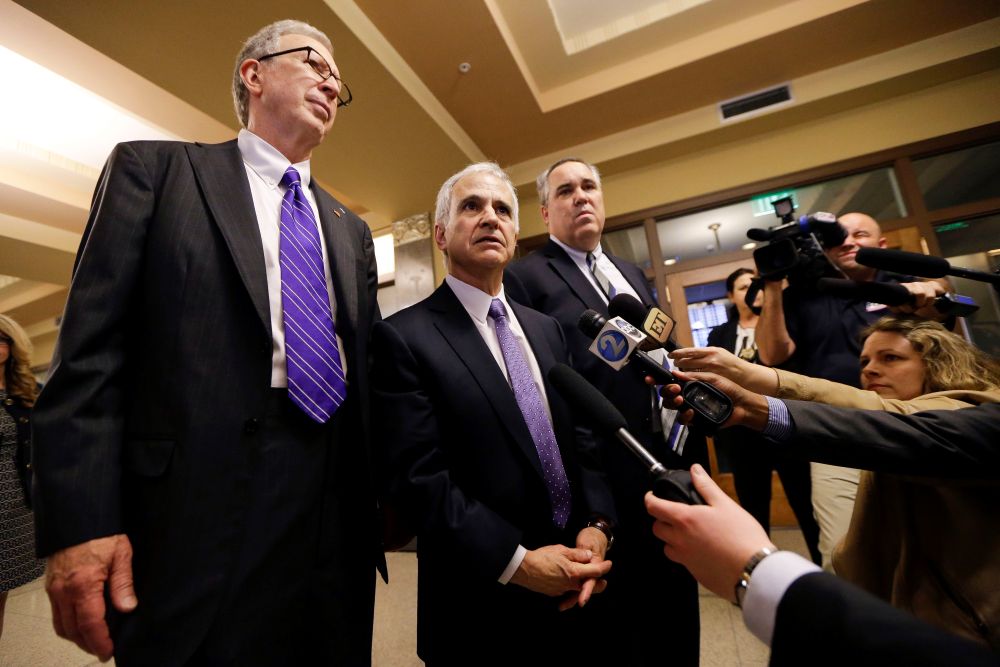
Broillet addressing media as he served as the co-lead trial attorney for sportscaster and television personality Erin Andrews in her high-profile 2016 civil lawsuit. (L-R): co-counsel Randall Kinnard, Broillet, and Scott Carr

Winning a case has never represented the end of the story for Broillet. Some verdicts compensated grieving families. Others forced industries to rethink dangerous practices. Together, they illustrate what he believes civil justice is designed to accomplish—not simply to compensate victims, but to prevent future tragedies.

The Hyatt case that recently captured headlines was especially searing. The woman at the center of it developed diabetic ketoacidosis alone in her hotel room. Instead of sending security to check on her when she failed to check out, staff merely extended her stay as she slipped further into crisis, unable even to call for help. Policies meant to protect guests were ignored, and the result was a preventable death.

For Broillet, the case was compelling not only because the liability was clear, but because of the profound loss it brought into the courtroom. In closing, he reminded jurors of the mother’s simple, devastating testimony – “she was my world” – and paired it with a line he had recently read: “To the world, you are one, but to me, you are the world.”

The Hyatt verdict joined a long list of outcomes that have reverberated well beyond a single courtroom. Broillet points to the Erin Andrews privacy case, which spurred hotels to rethink their procedures, as just one example of litigation forcing systemic change.

“There are endless examples of automobiles and other products that are safer because of lawsuits that were brought, not just by me, but by lawyers representing people who’ve been harmed all across America for many, many years,” Broillet observes. “When you hold wrongdoing corporations accountable for their conduct, they often respond to that by changing their conduct for the better to protect people.”


What Lies Ahead

While it’s obvious Broillet can be borderline obsessive when preparing for or in court, he also has the wisdom to appreciate the value of trying to keep balance in his life. All the more important to ensure he enjoys quality time with his wife, Norah, and their 29-year-old son, Dalton.

“I exercise a fair amount,” he acknowledges. “My wife and I like to go to the movies. I like to read subjects completely away from what I do. And we enjoy traveling. We go to a lot of sporting events with Dalton. But we have to remember, as my uncle once told me, the law is a jealous mistress.”

Across five decades in the courtroom, Bruce Broillet has watched technology transform the practice of law—from carbon paper and early word processors to real-time transcripts and sophisticated electronic filings. Yet, he insists that what matters most has not changed and should never change: one lawyer, 12 jurors, and a human story about what happened and what should be done about it. For all the complexity of modern litigation, he still sees trial work as a fundamentally human endeavor grounded in connection, clarity, and conviction.

That perspective shapes how he mentors the next generation. He looks for intellect and work ethic, of course, but he keeps coming back to one trait that can’t be faked: courage. Courage to stand in a public courtroom, present a client’s story, risk being turned away by a jury, and come back again after a loss. As he tells young lawyers, there is no way to grow into the work without stepping into that uncertainty.

“If you don’t let go of the side of the pool, you’ll never swim to the other side,” he says.

At a Glance

Greene, Broillet &
Wheeler LLP
222 N. Pacific Coast Highway
Ste 2100
El Segundo, CA 90245
(310) 576-1200 
www.gbw.law

Practice Areas

Education

Professional Memberships

Honors

Hobbies

family