




Nicholas Wood: Pursuing Perfection to Achieve Excellence

“Zoning, land use and structuring tax deals is the ultimate game of chess. I love the ‘game’ because you can’t cheat. Everything is on the board for everyone to see. The victory comes from strategy. It’s incredibly rewarding because you achieve a result that is tangible and generates tremendous value for the client,” says Nicholas Wood, partner at Snell & Wilmer. Wood has done legal work for 56 buildings in downtown Phoenix and has had a hand in almost every high-rise built in the past 20 years.

Wood’s father taught him chess from the age of 4 and he incorporates the principles of the game in his practice. “We have an opening, a middle game, and an end game where the project is approved by the City Council or, if you’re in the county, by the County Board of Supervisors. Developing and implementing a winning strategy is one of the things I especially love about what I do.”

Wood was born and raised in Milwaukee, Wisconsin. After law school he worked for a law firm there and served as an adjunct professor at Marquette Law School. Interested in developing a career in zoning, land use and related tax issues, he decided in 1985 to move to the financially hot market of Phoenix where he worked at a law firm active in real estate and tax law. He was recruited by Snell & Wilmer in 1993.

Loving and Thriving in Big Law

“Working in big law isn’t for everyone, but I love it,” Wood says. “Regardless of the size of the deal, the resources that Snell & Wilmer provides is second to none. But the firm has always recognized that the practice of law is a people business and that’s one of the things I really love about it. I can’t imagine not being at Snell & Wilmer, especially considering the variety of experiences I encounter every day. Even though I just turned 75, I still get up every day, and I can’t wait to go to work.”

Wood begins each day at 5:30 A.M. with a workout at the gym followed by breakfast with his wife. His work day is a series of meetings with clients, architects, civil engineers and traffic engineers, landscape architects, outreach people, planning directors and members of planning departments. He also regularly meets with members of village planning committees, which are advisory groups, and part of the zoning process, as well as with planning commissioners, mayors, and council members. Nights during the week may include hearings, because most city council hearings, planning commission hearings, neighborhood meetings, and planning committees occur at night.

Wood is very inclusive when it comes to outreach to stakeholders, the people who own property right next door, or in close proximity, or have an interest in a given project. Wood and his team meet with them individually and at more formal neighborhood meetings, where they explain the project, the design, and everything from the development standards, which are building heights, building setbacks and parking ratios, as well as design standards, and architecture.

Regardless of the technical and legal side of things, for Wood it’s still a people business. They mostly listen to area residents’ thoughts and concerns and take their input. He uses that information in planning the project at hand. It’s not unusual for the client to make changes in design, and modifications to everything from building heights to building orientations based on such input.

It’s a very busy practice where he enjoys meeting people, even neighborhood groups who are in opposition in his cases. “My dad always told me that the first casualty of emotion is reason. You never let yourself become emotional or take things personally because when you have neighbors who are concerned about how your project may impact them, the experience can be very emotional for them. And it’s important for me, especially as the leader of the team, to be very respectful, treat them with courtesy and dignity and listen and respond to them in ways that lead to satisfactory outcomes.”

Typical Client

Most of Wood’s clients are developers who place a piece of property under contract. The contract will include not only a 90-day due diligence period, so they can take a look at title and survey and environmental and other concerns, but also a zoning contingency. Basically, they’re not obligated to close on the acquisition of the property until all the zoning has been completed and approved. Essentially, they’re buying a piece of land upon which they can build whatever it is they choose to build.

Wood also represents a number of major resorts in the Phoenix area, where Wood’s team helped with design, modifications, and plans for future expansions.

The firm has eight land planners, six of whom are in the Phoenix office. “We stay busy. We constantly have at least 100 open cases with our team here in the Phoenix office alone. And so, it’s a very busy practice, and it’s fun,” he says.

“People often ask me to explain why I have been so successful year-in and year-out. One reason is that no one outworks me. However, the main reason is that I surround myself with the best and the brightest. Our zoning and land use team is second to none.”

People often ask me to explain why I have been so successful year-in and year-out. One reason is that no one outworks me.

‘I Will Never Ask You to Trust Me’

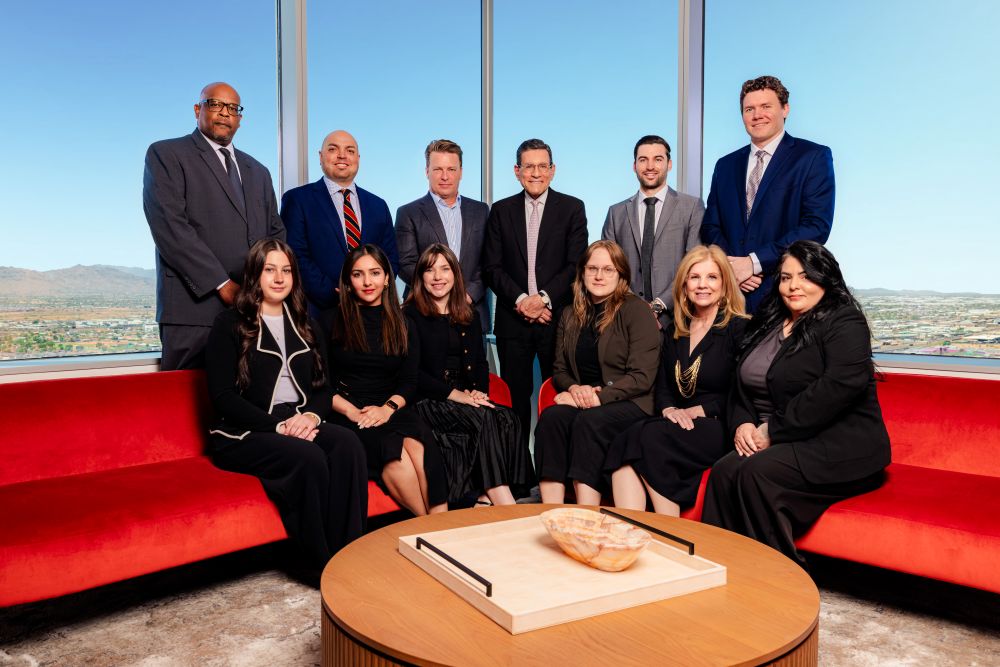
The Zoning and Land Use Team: Standing: Erving Griffin, Ray Banker, Noel Griemsmann, Nick Wood, Mike Maerowitz, Bennett Houck. Seated: Chloe Eisenhart, Simran Shah, Maggie Dellow, Sarah Schiele, Jeanette Williams, Jessica Suarez. Not pictured: Ryan McCann and Chris Colyer.

Wood has a unique approach when representing developers to communities, neighbors and individual people. “I will never ask you to trust me … I’m a lawyer,” he says. The statement usually generates a laugh and a quizzical expression. He continues with an explanation. “You don’t know me, right? You just met me for the first time and trust is something that must be earned over time. Now, during this process, I hope to earn that trust. But at the end of the day, you really don’t have to trust me. And the reason is that all the things that I promise will be done, and what my client promises to do, will be incorporated in writing in the final approvals.”

He notes that, as in chess, all the pieces will be placed openly for all to see, so there will be no surprises. His unusual and open approach works well in opening the lines of communication and in keeping them open.

Pursuing Perfection to Achieve Excellence

“My dad said, ‘No one can ever achieve perfection. It’s just not possible. But by striving for and pursuing perfection, that’s how you achieve excellence.’ I have adopted that mantra as my own in my personal as well as my professional life. It’s also a key principle here at Snell & Wilmer.”

The culture of the firm is committed first and foremost to providing excellent legal services to the client so that the client feels good about the relationship, feels well-represented, observes great work and feels thrilled with our excellent result. More importantly, Wood says the culture is all about family and that the men and women in the firm know and understand that the firm really does care about them as individual people. The firm is always there to support them regardless of the issue they face.

Snell implemented a “No Jerks” hiring policy to recruit and maintain a team of attorneys and a staff committed to excellence. “A no jerk rule means exactly what it suggests. We don’t permit jerks to be part of this firm. We won’t hire them if we perceive them to be jerks. And if they are hired and turn out to be jerks, they won’t be around very long.”

The firm puts prospective employees through a careful and intensive interview process, a review of letters of recommendation, and, most important, he says, is following one’s gut instinct about the likely success of the applicant.

“One of the primary reasons we’re so highly regarded is the quality of the people working here. Applicants learn of our no jerks policy and our clients quickly learn to appreciate what that means for the quality of the service they receive. We have a total commitment to excellence. No one is perfect, but that’s what you shoot for. That’s how you achieve excellence,” Wood says.


Nicholas Wood

Supporting the Community He Helps Build

The attorneys and staff in the 17 Snell offices are active in the community at large, investing time and expertise in important charitable services and organizations. The attorneys are active in volunteer lawyer programs that aid people who can’t afford legal services, committing thousands of hours of lawyer time helping people who wouldn’t otherwise be able to afford legal help. The partners, without exception serve on boards of directors for nonprofits in every respect.

Wood has served as a pro bono lawyer for the largest homeless shelter in the state for the past 20 years. Also, as a Stage Four cancer survivor, he devotes a considerable amount of his time and energy to raising funds for cancer research, treatment and patient and family support. “The challenges are many, it’s very rewarding. And I make many friends along the way,” Wood says.

Wood and his wife, Jennifer, have five children. “In terms of personal success, I love my kids and my wife is my best friend, so I’m the luckiest man alive. On a professional level, I can see a lot of what I have achieved just by looking out my office window. At one time, all those buildings weren’t there. Now they are and I can honestly say, ‘I did that. Yeah, I did that.’”

At A Glance

Snell & Wilmer
1 E. Washington St. Suite 2700
Phoenix, AZ 85004
(602) 382-6000
swlaw.com

Practice Areas

Education

Professional Recognition

Community Involvement

Hobbies

Favorite Quote