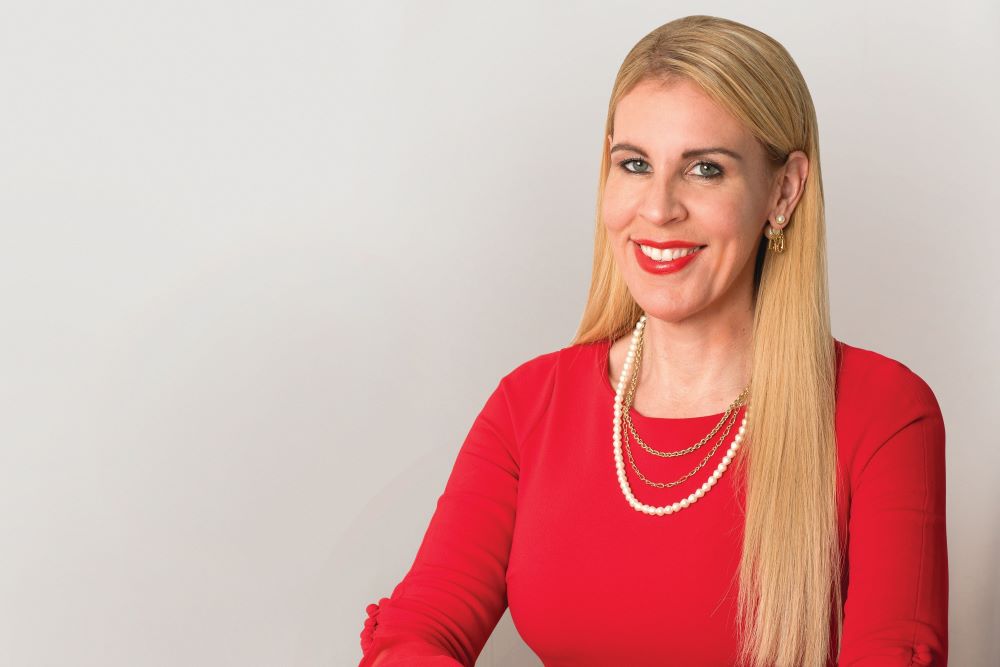

When Dominique Bartholet begins her workday, she takes notes on a yellow legal pad amidst an office filled with Wonder Woman memorabilia, in homage to her favorite superhero. To Bartholet, Wonder Woman represents the strength, resilience, and unwavering determination she relies on every day in mediation. The notes on her pages shift between English and Spanish as she moves from Spanish-speaking participants to English-speaking attorneys.
“It’s one thing for an attorney or mediator to speak Spanish; it’s something else entirely to understand the cultural nuances that shape communication,” Bartholet said.
In 2021, she made a courageous and life-altering decision—she left her litigation position of more than 20 years to found Bartholet Mediation.
As she grew her business, Bartholet identified a natural niche where she could distinguish herself: she facilitates mediations in both English and Spanish, making her a perfect choice for attorneys with Spanish-speaking participants.
Born in Colombia, she came to the United States as a teenager, learning English as her third language after Spanish and French. Bartholet grew up navigating between Colombian and Texan cultures—an experience that gave her a deep appreciation for the values, perspectives, and communication styles that influence how people express themselves during conflict.
This bicultural background allows her to bridge gaps that are often overlooked. “Fluency isn’t just about the words,” Bartholet explained. “It’s about understanding tone, context, cultural meaning, and what someone is trying to communicate beneath the surface. Mediation requires all of that.”
Bartholet emphasized that the foundation of mediation is neutrality. “A mediator’s role is not to determine who is right or wrong,” she says. “Our responsibility is to remain impartial, help the parties communicate clearly, and support them as they work toward their own resolution.”
To that end, Bartholet aims to provide a neutral and confidential environment where parties can openly express concerns, clarify misunderstandings, and explore options without fear of judgment. By fostering open communication and collaboration, the parties can understand one another’s perspectives and work toward mutually acceptable solutions.
Her cultural insight and language fluency assists her in dealing with the changing demographics of plaintiffs participating in civil disputes. As more and more cases involve Spanish-speaking individuals and families, having a mediator who understands the language as well as the cultural context greatly enhances the process.
“Every participant deserves to feel respected, heard, and understood,” she notes. “Being bilingual and bicultural allows me to bridge gaps that might otherwise create misunderstanding.
She doesn’t see it as a simple business advantage, rather an aspect of her services that “ensures fairness and clarity” for everyone involved.
Bartholet is dedicated to her professional development. Beyond completing the required 40-hour Texas Mediation training to begin her practice, she has also completed the Mediation Intensive Training Program and the Negotiation and Leadership course at Harvard Law School. She plans to participate in Harvard’s Advance Mediation Intensive in 2026.
“Basic training is where we begin, not where we stop,” she said. “A simple 40-hour course cannot be enough.”
In these various courses, Bartholet met law professionals and neutrals from across the country and the world, further assisting her in working with participants and clients of all backgrounds. She feels these connections have helped her to focus not only on what is said in mediation, but how it is said, in order to better serve those she works with.
“A mediator helps the parties surface the risks, realities, and opportunities they may not see on their own,” Bartholet explains. “But sometimes certain voices can get tuned out, and that’s when a neutral perspective can bring clarity and help move the conversation forward.”
That need for recognizing how different cases involve different dynamics, personalities, and communication styles might have also contributed to the steady rise in female mediators that Bartholet has observed. For her, that development reflects the evolution of the profession.
“Every case has its own energy,” Bartholet shared. “Some situations benefit from a softer approach, others from a more direct tone, and many from a balanced blend. The growth [of female mediators] gives parties more options to find the neutral whose style best supports them.”
After five years building her mediation practice from the ground up, Bartholet has been reflecting on how her shift from civil litigation to full-time mediation is at the heart of her professional second act.
“For me, mediation isn’t simply a second career—it’s the next chapter of the same story,” Bartholet said.
For two decades, she practiced complex civil litigation—a demanding, fast-paced profession that required deep strategic thinking, and meticulous preparation. Over time, she realized that her skills, temperament, and passion aligned more naturally with facilitating dispute resolution through negotiation, rather than with courtroom battles.
For Dominique Bartholet, choosing to leave litigation was not an ending, but a beginning.
“My litigation experience shaped me, but mediation fulfills me,” she said. “Act One was about advocacy. Act Two is about neutrality, clarity, and helping people find resolution.”
She asserted that she would not be the mediator she is today without first having the experience of being a litigator.
“But when I found mediation, I knew this was my true calling,” Bartholet said.
For more information, please visit bartholetmediation.com.