
Recent legal disputes involving drag performers and established brands have spurred discussion in legal and entertainment circles alike about the complex intersection of modern trademark law, activism, and values-driven branding. The ongoing high-profile a trademark lawsuit between Patagonia, a leading outdoor apparel company, and Pattie Gonia, a popular drag queen and environment activist, offers more than just colorful headlines. It illustrates a growing friction between expressive parody, commercial identity, and the boundaries of intellectual property protection in an environment where every social media post can double as both performance and product placement.
Expressive Trademarks and the Social Media Drag Race
Drag culture has long thrived on clever, pun-heavy stage names. While some trend toward the macabre or juvenile (like “Daya Betty,” who often highlights her Type 1 Diabetes, and Sigourney Beaver, who pays homage in a way to actress Sigourney Weaver), a common trend has seen queens riff on famous marks or products in a wink to popular culture. Trixie Mattel, a popular winner of RuPaul’s Drag Race All Stars, chose her last name because of her affinity for Barbie. Recently, queens like Brita Filter and Jan Sport have appeared on RuPaul’s Drag Race and dropped their corporate surnames out of reported caution for running afoul of any trademark issues. With Jan Sport, RuPaul leaned into the trademark situation, occasionally referring to the queen as “Jan Backpack.” The punchline was clear; the legal risk, once Jan became a touring, merchandising artist, was too.
Many drag queen names that wink at corporate marks or products never draw objection because they remain niche, clearly parodic, or non-commercial. Trixie Mattel does not sell dolls, Brita Filter does not sell water filters, and Jan Sport—except for a recent collaboration with the JANSPORT company—does not sell her own line of backpacks. Audiences understand the names as camp references, not as competing labels in the same commercial space as their corporate influences. In the context of local or regional drag scenes, there is little practical concern that a corporate rights holder’s customers will genuinely believe they are attending a sanctioned brand event or buying official merchandise.

The calculus changes once drag personas become corporatized—when follower counts climb into the hundreds of thousands, social media handles become storefronts, and the name sits on webshops, sponsorship posts, and branded apparel. When those names become highly monetized and cross over into the same or adjacent goods and services as the original brand, trademark law starts paying much closer attention. When an artist’s persona is no longer just performing with the brand—and is, in effect, competing alongside it—the line between homage and infringement begins to need legal contouring.
Trademark Law’s Balancing Act: Fair Use, Values Alignment, and the Duty to Police
In a cultural landscape where parody, homage, and brand commentary share the same stage—and the same social media feed—the legal question becomes: how far can an artist “lip‑sync” off a famous brand before a court will tell her to sashay away? Doctrinally, these disputes sit at the intersection of traditional trademark protection and First Amendment interests in expressive works. The courts have long recognized the legitimacy of strong trademark enforcement while acknowledging that marks often appear inside expressive content.
The Rogers test, developed in Rogers v. Grimaldi, 875 F.2d 994 (2d Cir. 1989), has long been the go‑to standard when defendants argue that their use of a mark is part of an artistic work. Such use is generally allowed unless: (1) the use of the mark has no artistic relevance to the underlying work, or (2) the use explicitly misleads consumers as to the source or sponsorship. This test can be thanked for allowing Acqua’s Barbie Girl to stick in your head decades after its release, and it has been a key tool for balancing Lanham Act claims against artistic expression.
But the Supreme Court’s recent decision in Jack Daniel’s Props., Inc. v. VIP Prods. LLC, 599 U.S. 140 (2023), arguably narrowed the practical reach of Rogers by holding that when a defendant uses a mark as a source identifier for its own goods—rather than merely referring to or commenting on it within a work—courts should apply ordinary likelihood‑of‑confusion analysis instead of utilizing Rogers’ heightened First Amendment shield.

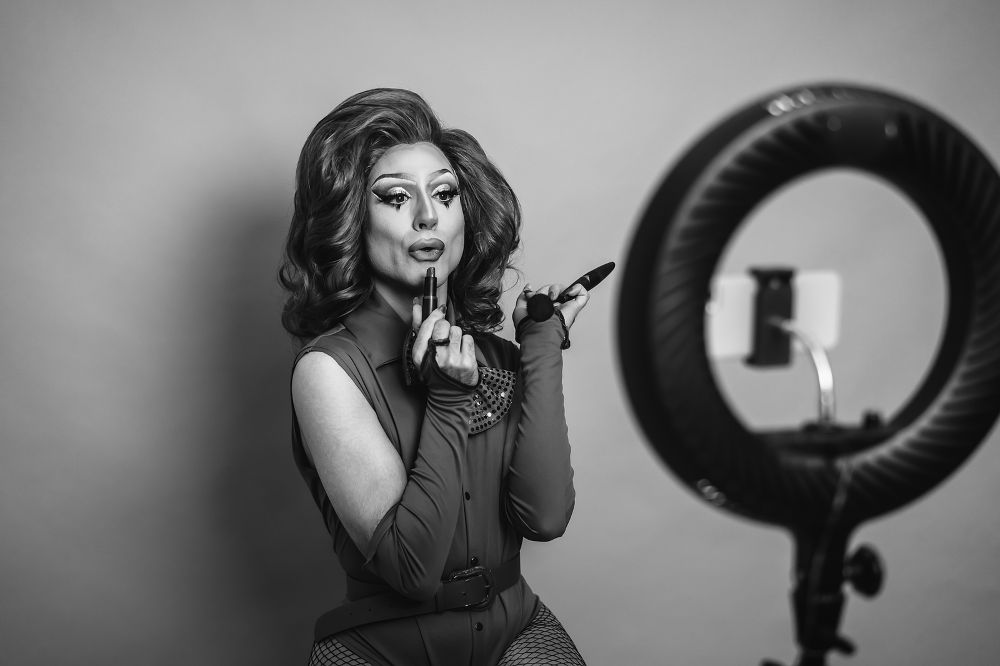
But the rise of social media has blurred the distinction between expressive performance and commercial use. Drag has always been a form of art, commentary, and camp; what is different now is that the same reel or TikTok can be simultaneously a performance, an ad, and a fundraising pitch. In prior cases like Mattel v. MCA (the “Barbie Girl” song) and Louis Vuitton Malletier S.A. v. Haute Diggity Dog, LLC, 507 F.3d 252 (4th Cir. 2007) (the “Chewy Vuiton” dog toys), courts evaluated parody in relatively discrete channels: a CD, a toy line, a print ad. Today, the channel is an ecosystem: a persona’s name, likeness, logo, and catchphrases appear in videos, comments, collabs, and branded content, often with affiliate links just a click away. In a social media environment where a drag persona’s name, handle, and logo function as the brand for content, merch, and sponsorships, that distinction is critical. What might once have looked like pure artistic commentary can start to look, in legal terms, like another label on the rack.
Social media also accelerates the potential for harm—and for confusion. The transition from niche joke to global brand occurs much faster. A viral post can reach millions before a rights holder has time to issue a demand letter. User‑generated content, reposts, and duets can remix a brand’s mark into contexts the company never anticipated. In that sense, the digital runway makes every performance potentially global and permanent, raising the stakes for both creators and brands when a name skirts closely around a famous mark.
This ecosystem complicates the legal analysis. A drag persona may be undeniably expressive—serving looks and climate education in equal measure—but the name and brand imagery also function as source identifiers across platforms. Under Jack Daniel’s, that dual role matters. Courts are more likely to apply traditional likelihood‑of‑confusion factors where the contested use is tied to the user’s own goods and services, even if the presentation is campy. In practice, courts must determine whether followers perceive the drag persona as a joke or as unofficial co‑branding. The question is difficult to answer, particularly because the ubiquity of influencer partnerships on social media can make implied sponsorship more likely in the eyes of consumers who are used to seeing brands and creators in constant collaboration.
Values Alignment, ‘Bad Actors,’ and the Duty to Police—Even When the Message Slays
A central tension in recent trademark battles is the dichotomy between the parties’ public values and the cold logic of trademark doctrine. For example, the U.S. Supreme Court may soon chime in on a years-long dispute involving LeBron James and a Maryland basketball nonprofit over the nonprofit’s claim to the phrase “I Am More Than an Athlete.” Despite the nonprofit’s potential synergy with the values of James, who is widely known for his charity work, the only thing that mattered to the Trademark Trial and Appeal Board in siding against the nonprofit was the common law rights attributed to the disputed phrase.

Similarly, Nike recently settled a lawsuit against Dominic Ciambrone, known as “The Shoe Surgeon,” despite working with Ciambrone on multiple celebrity collaborations. When Ciambrone started independently collaborating with other brands, Nike stopped appreciating the “art” they previously celebrated and filed a lawsuit instead. The parties’ settlement allows Ciambrone to create customized Nike shoes but prohibits selling them for commercial purposes.
Ultimately, trademark law is not a values‑based test; it does not ask whether the defendant is advancing climate action, queer visibility, or other goals a brand might cheer. Under U.S. law, trademark owners risk eroding their rights if they fail to police confusingly similar uses. Tolerating a prominent, values‑aligned use can become a problem later when a bad actor adopts a closer or more harmful variant. That subsequent defendant may point to the earlier, unchallenged use as evidence that the mark is not as exclusive or distinctive as claimed, or that consumers can handle significant variations without confusion.
The broader evidentiary principle is logical: inconsistent or selective enforcement can undermine a brand’s story that it has always guarded its mark like a crown jewel. That’s why companies sometimes feel compelled to enforce against “good” infringers whose messages they largely endorse. It also exemplifies why certain drag personas—like Trixie Mattel, Brita Filter, and Jan Sport—have avoided trademark battles of their own. Trademark law is less concerned about drag queens making a name for themselves in entertainment but is instead focused on the broader commercialization of a name and related branding. The issue is not the existence of the joke, but its transformation into a parallel brand that risks confusion and dilution of famous marks.
If companies allow drag personas to commercialize names and logos that a court might later deem confusingly similar, a counterfeiter or disparaging user could argue that the companies effectively conceded that such a degree of variation is acceptable. The company may then find it harder to persuade a court that a less sympathetic defendant crosses the line.
For rights holders with strong environmental, social, and governance identities, this is a particularly delicate dance. Stakeholders may expect values-based companies to support, not sue, aligned activists and queer creators. But the legal framework gives brand owners limited room to factor in that nuance: confusion, dilution, and defenses like fair use and expressive use are the central questions, not whether the defendant supports the brand-holder’s mission. The result is that companies sometimes must issue cease‑and‑desist letters or bring lawsuits with one hand while applauding the defendant’s broader message with the other.
Brands, Personas, and the Expressive Dimension of Trademarks
Overlaying these issues is a larger conversation about the expressive character of trademarks in contemporary culture. Many successful companies rely on more complex identities than simply a corporate label; their names and imagery are intended to signal a particular social ethic. Potential trademark infringers likewise hope that their riffs on the corporate name endear fans to a persona that more deeply reflects the artist’s values. When these identities collide in litigation, the courts will determine not only a source‑confusion dispute, but a clash between two expressive “houses,” each with its own aesthetic, message, and following.
The courts’ recognition that trademarks themselves carry expressive content underscores that restrictions on trademark use and registration may implicate broader free speech ideals. That recognition complicates any simple division between “commercial” and “expressive” uses. Alleged infringement can itself be an expressive identity built in tandem with an existing brand identity; the mark can be both a punchline and a platform. The legal challenge is to determine if that platform is merely commenting on the existing brand or if it is, in effect, performing as a parallel brand sharing the same stage.
Cultural Context, Platforms, and the Road Ahead
These issues raise broader cultural and technological questions that the Lanham Act only partially anticipates. Drag, by design, transforms mainstream imagery, bending gender, fashion, and consumer culture into new forms. Social media has amplified that tradition, giving performers global stages, built‑in audiences, and monetization tools that turn every look into potential licensed (or unlicensed) merch. A persona that once worked a single local bar can now sell tickets, T‑shirts, and cause‑based collaborations worldwide—all under a name that riffs on a famous brand.
For drag performers, these cases serve as a reminder that pun‑based names borrowed from corporate marks may carry more legal risk once the persona becomes a business, particularly in the hyper‑commercialized environment of influencer culture. For brands, it highlights how values‑aligned creators can become both natural partners and inadvertent legal risks, especially when their identities are built around the brand itself. And for courts, they present the ongoing challenge of applying traditional confusion and dilution tests to an arena where entertainment, commerce, and activism are inseparable—and where consumers are accustomed to seeing brands and creators in constant cross‑promotion.
The evolving landscape of brand parody, digital platforms, and expressive content ensures that these questions will be litigated well beyond any single lawsuit. Each case—whether headline-grabbing or quietly settled—helps to clarify the boundaries between parody and infringement, supporting a dynamic in which every creator is a brand and every brand performs its values. As law, culture, and commerce converge, the show—and the debate about expressive trademarks and identity—must go on.